In the world of online trading, understanding how brokers operate is essential. A-Book vs B-Book brokers is one of the most important distinctions, as it directly impacts execution quality, risk exposure, and long-term profitability.
Whether you are launching a brokerage or scaling an existing operation, the execution model you choose shapes how your business performs under different market conditions.
This guide breaks down how each model works, how brokers generate revenue, and why most modern firms rely on a hybrid approach.
What Are A-Book vs B-Book Brokers?
At its core, the difference between A-Book vs B-Book brokers comes down to what happens after a trade is placed.
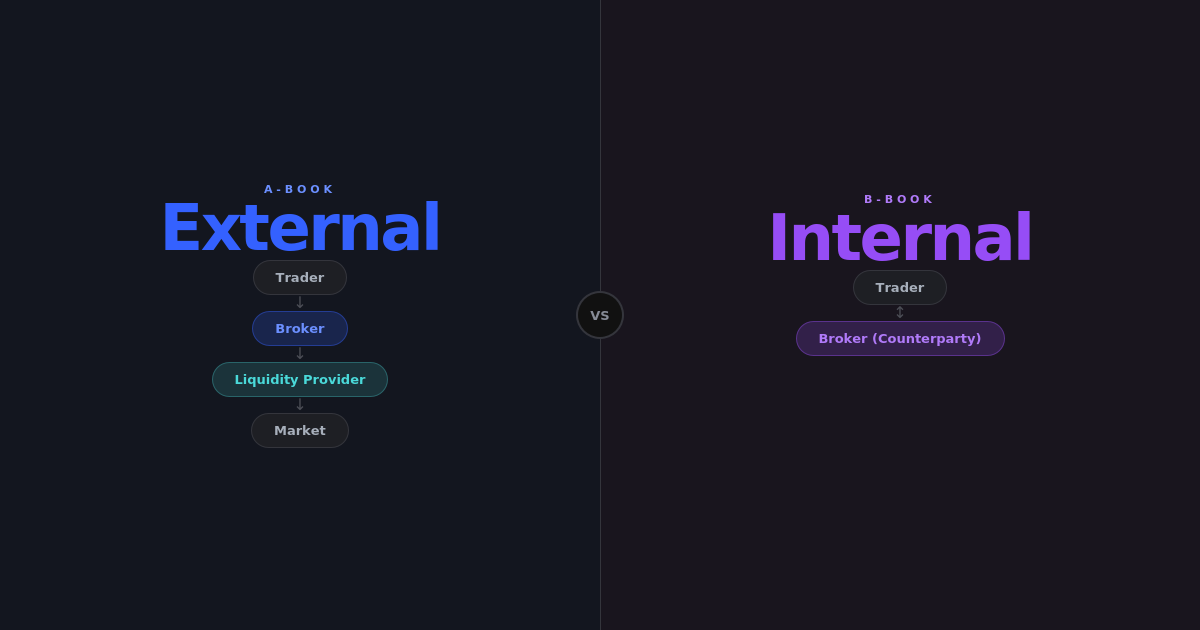
An A-Book broker routes trades to external liquidity providers, effectively acting as a middleman between the trader and the market.
A B-Book broker, on the other hand, keeps trades in-house and becomes the counterparty to the trader.
The difference comes down to how trades are handled after a trader clicks “buy” or “sell.”
- A-Book brokers pass trades directly to external liquidity providers (LPs)
- B-Book brokers internalize trades and take the opposite side
Both models are widely used, and neither is inherently better. The real difference lies in how they handle risk, execution, and revenue generation.
What Is an A-Book Broker?
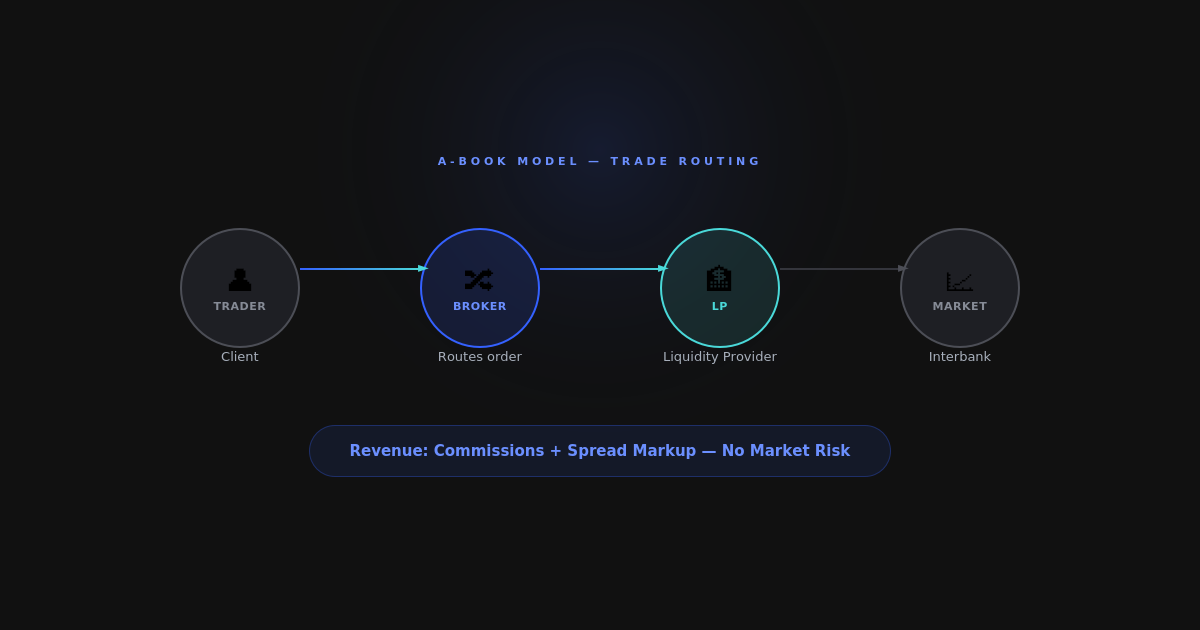
An A-Book broker, often referred to as an STP or ECN broker, passes all client trades directly to the market through liquidity providers such as banks or prime brokers. In this setup, the broker does not take on market risk, as it is not exposed to the outcome of trades.
Instead, revenue comes from commissions or spread markups, meaning the broker benefits from trading volume rather than trader losses. This creates a more neutral alignment between broker and client, which is often associated with higher levels of trust and transparency.
Key characteristics:
- No conflict of interest. Broker doesn’t profit from trader losses.
- Transparent execution. Prices come from external markets.
- Lower risk for the broker. No exposure to client positions.
However, this model introduces dependencies. Execution quality relies heavily on liquidity providers, and margins tend to be lower compared to internalization models. For brokers, success with A-Book requires strong infrastructure and reliable liquidity relationships.
For a deeper look at how trading environments are structured, explore the TradeLocker Back Office.
What Is a B-Book Broker?
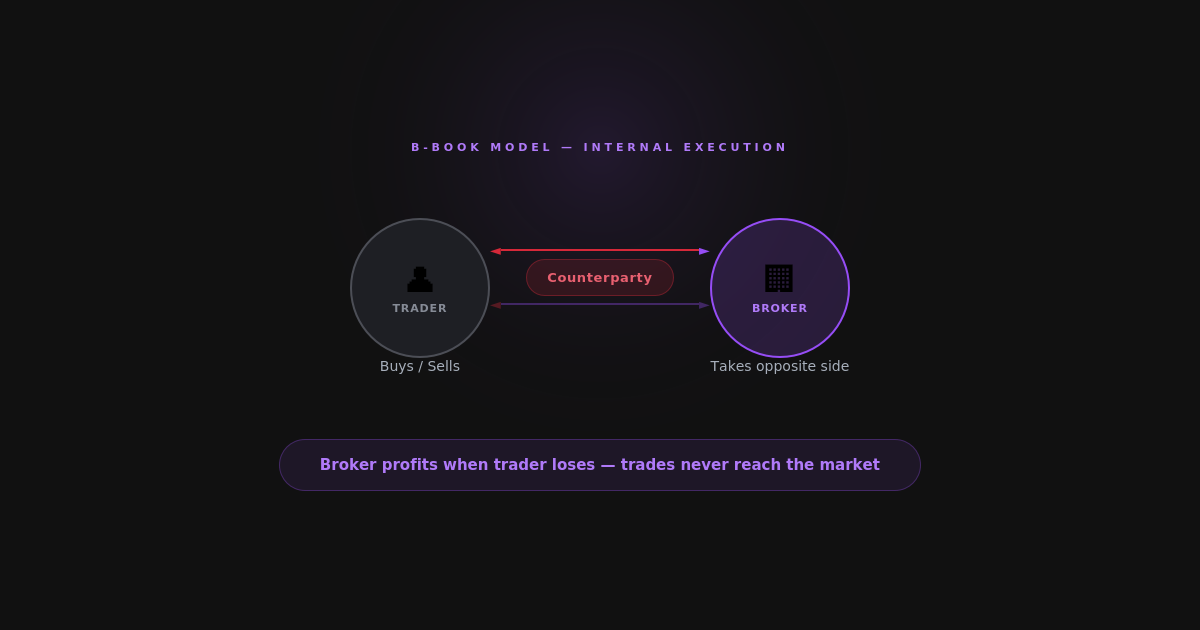
A B-Book broker operates differently by internalizing trades. Instead of sending orders to the market, the broker takes the opposite side of each trade. This means the broker’s profit is directly tied to trader performance.
In practice, this allows for significantly higher margins. When traders lose, the broker profits. But this also introduces risk exposure, especially when dealing with consistently profitable traders or volatile market conditions.
Because of this, B-Book brokers rely heavily on risk management systems to balance exposure and maintain profitability over time. While the model offers control and flexibility, it requires careful execution to avoid large drawdowns.
Key characteristics:
- Higher profit potential. Broker earns when traders lose.
- Full control over execution.
- Increased risk exposure. Especially with profitable traders.
A-Book vs B-Book Brokers Brokers Comparison
| Feature | A-Book | B-Book |
|---|---|---|
| Trade Routing | External (LPs) | Internal |
| Risk Exposure | Low | High |
| Revenue Source | Commissions, spreads | Client losses, spreads |
| Conflict of Interest | Minimal | Present |
| Execution Control | Limited | Full |
The distinction between these two models becomes clearer when looking at how they approach execution and revenue.
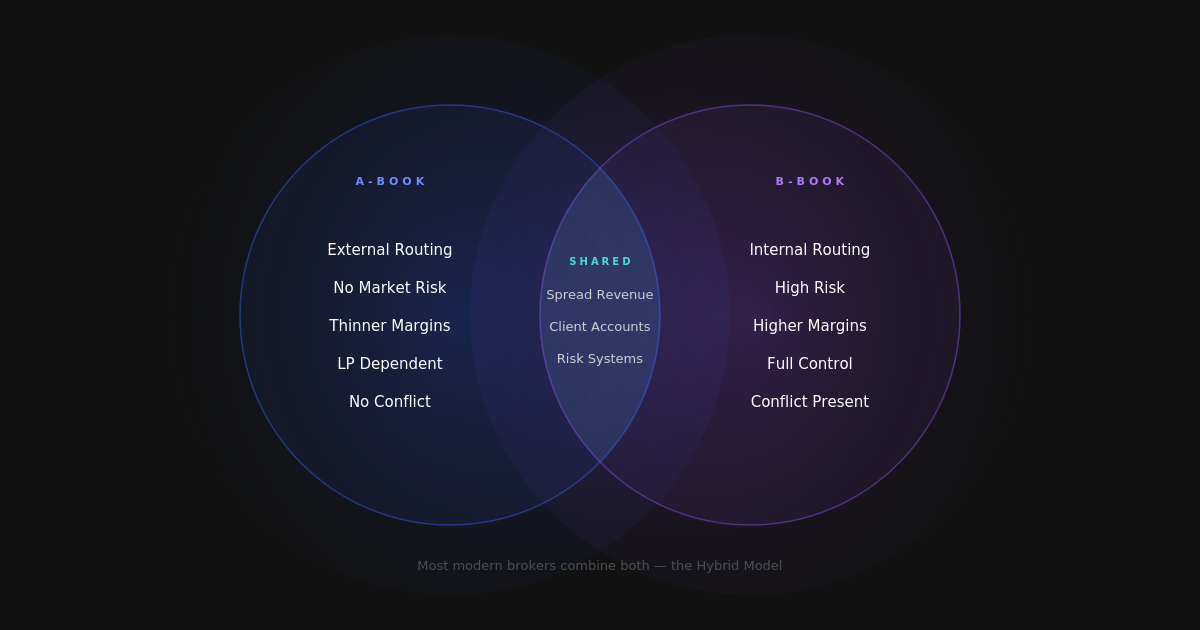
A-Book brokers focus on external execution and volume-based revenue, resulting in lower risk but thinner margins. B-Book brokers prioritize internal execution and profit from client losses, which increases potential profitability but also introduces risk.
Another key difference is control. A-Book brokers rely on external pricing and liquidity, while B-Book brokers have full control over execution, allowing them to optimize spreads, slippage, and internal matching.
Pros and Cons of Each Model
A-Book Pros
- Trust and transparency
- Reduced regulatory concerns
- Scalable with the right liquidity setup
A-Book Cons
- Lower margins
- Dependence on external providers
- Requires strong infrastructure
B-Book Pros
- Higher profitability potential
- Full control over pricing and execution
- Ability to optimize internal flow
B-Book Cons
- Risk of large losses from profitable traders
- Perceived conflict of interest
- Requires sophisticated risk management
The Hybrid Model: Where Most Brokers Land
In reality, most brokers today do not strictly operate as either A-Book or B-Book. Instead, they combine both models into a hybrid execution system.
Hybrid execution routes trades based on real-time risk assessment, where lower-risk flow is often internalized (B-Book), and higher-risk or consistently profitable flow is more likely routed externally (A-Book).
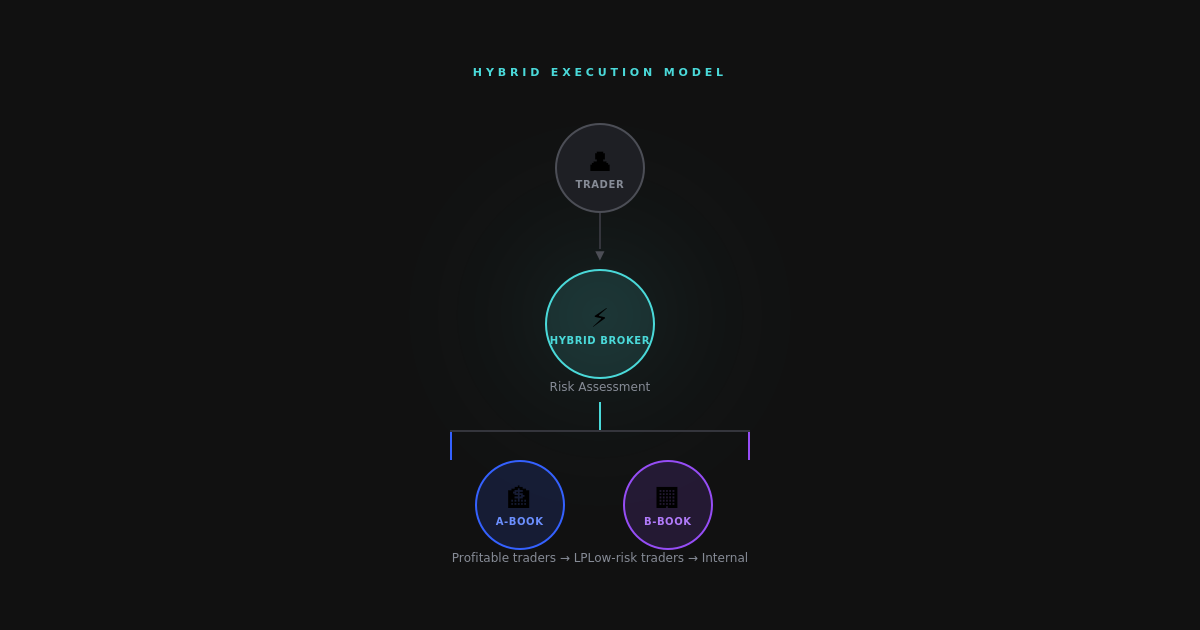
This approach allows brokers to dynamically route trades based on trader behavior and risk profiles. Less experienced or unprofitable traders are typically handled internally, while more consistent or high-performing traders are routed to external liquidity providers.
The result is a system that balances profitability and risk management. Brokers can capture higher margins where appropriate while protecting themselves from large exposures when needed.
This type of setup requires real-time data, automation, and advanced routing logic, all of which are supported by modern trading infrastructure. Learn how this works in practice through the TradeLocker integration ecosystem.
Why Execution Model Matters for Your Brokerage
The choice between A-Book vs B-Book brokers is not just a technical decision. It directly impacts how your brokerage grows, how it manages risk, and how traders perceive your brand.
A purely A-Book model may limit profitability but strengthen trust and regulatory positioning. A B-Book model can significantly increase margins but requires sophisticated risk controls to remain sustainable. A hybrid model, when executed correctly, allows brokers to adapt to market conditions and trader behavior in real time.
Ultimately, the right approach depends on your business model, target audience, and long-term strategy.
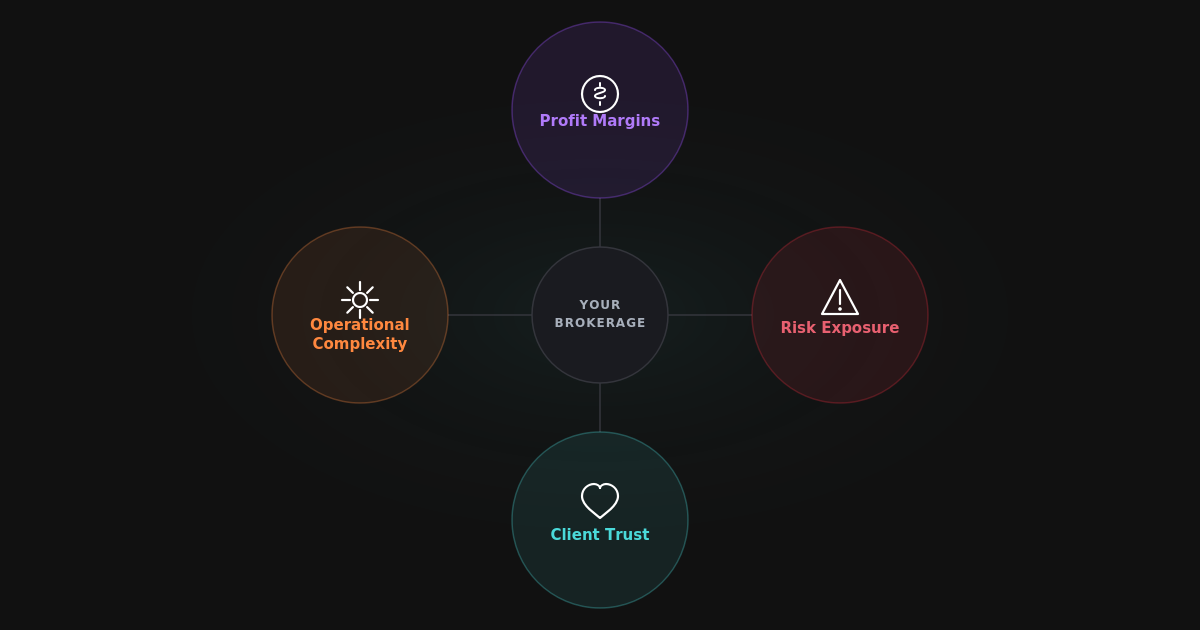
Choosing between A-Book vs B-Book brokers, or implementing a hybrid model, directly impacts:
- Profit margins
- Risk exposure
- Client trust
- Operational complexity
Building the Right Brokerage Setup
Execution is only one part of launching a successful brokerage.
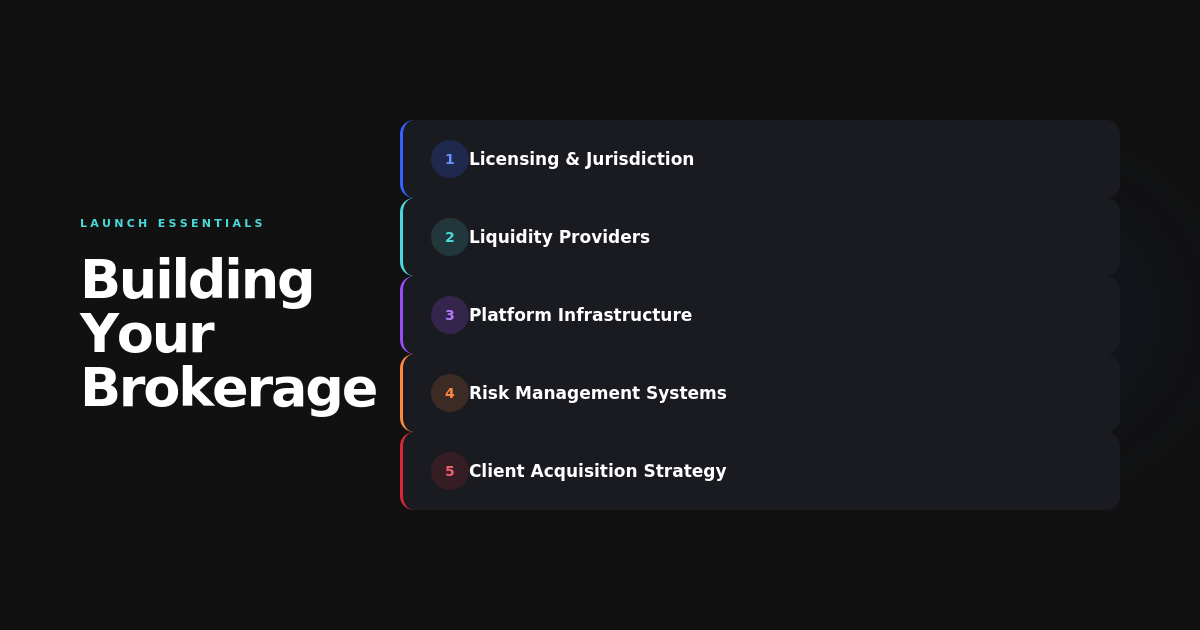
You also need to consider:
- Licensing and jurisdiction
- Liquidity providers
- Platform infrastructure
- Risk management systems
- Client acquisition strategy
👉 Want a complete breakdown?
Get the free Brokerage Launch Blueprint. It is a structured guide covering costs, setup, tech stack, and operations, so you can build your brokerage with clarity and avoid costly mistakes.
Conclusion: A-Book vs B-Book Brokers
Understanding A-Book vs B-Book brokers is fundamental to building a sustainable trading business. Each model offers distinct advantages, but the real edge comes from how effectively they are implemented.
A-Book prioritizes transparency and scalability, B-Book focuses on profitability and control, while hybrid models enable brokers to combine both in a way that adapts over time.
The brokers that succeed long term are those that align their execution model with strong infrastructure, smart risk management, and a clear strategic vision.