Day trading isn’t about finding a “secret indicator.” It’s about running a repeatable playbook with tight risk control—again and again—until it becomes boring.
In this guide, you’ll learn beginner-friendly strategies with clear, practical rules. By the end, you’ll know when to trade, how to choose entries, where a trade is invalid (stop-loss), how to take profits, and how much to risk so one bad trade doesn’t wreck your week.
What counts as a day trading strategy
A day trading strategy is a set of rules that helps you make the same type of decision under similar conditions—without improvising every trade. It’s not a chart layout. It’s not a Telegram signal. And it definitely isn’t stacking indicators until you feel confident.
A complete strategy has four parts. First, there’s the setup: what must be true before you even consider entering. Then comes the trigger, which is the exact moment you act. Next is the invalidation point, meaning the price level that proves you were wrong—your stop-loss should sit here. Finally, there’s the exit plan, which covers how you take profits and how you manage the trade if it starts moving in your favor.
If your “strategy” doesn’t have all four, it’s not really a strategy. It’s a vibe.
The 60-second beginner strategy picker
A lot of beginner losses happen because people use a good strategy in the wrong market. A breakout strategy inside a range will get chopped up. A range strategy during a trend will get steamrolled. So before you even think about entry signals, start with one quick question:
What kind of market is this right now?
If price is making higher highs and higher lows, you’re likely in an uptrend. If it’s making lower highs and lower lows, that’s a downtrend. In those conditions, beginner-friendly approaches like pullbacks and momentum continuation tend to make more sense because you’re working with the dominant direction instead of fighting it.
If price keeps bouncing between clear support and resistance, you’re likely in a range. That’s where range trades and simple mean reversion ideas shine—because the market is repeatedly snapping back from the edges.
And if volatility is spiking—big candles, fast moves, spreads widening—you’re in a different game. For beginners, the best move is usually trading smaller or standing aside unless you have a rules-based plan built specifically for that kind of speed.
The beginner rules that make any strategy work
If you want “strategies that work,” these rules are the foundation. Without them, even the best setups turn into emotional trades.
Rule #1: Risk a fixed amount per trade
Most beginners do the opposite: they trade the same size every time, even when their stop-loss is far away or very close. That’s how risk quietly explodes.
Instead, decide risk first. If your account is $1,000 and you risk 1% per trade, that means your maximum loss is $10. From there, your stop-loss distance determines position size. This keeps risk stable even when market conditions change.
Rule #2: Put your stop where the trade is wrong, not where it “feels safe”
A stop-loss isn’t a comfort blanket. It’s an invalidation point. For a long trade, it usually goes below the swing low that should hold if the trend is real. For a short trade, it usually goes above the swing high. If you’re placing stops at random distances like “5 pips because I’m nervous,” you’re not managing risk—you’re guessing.
Rule #3: Set a daily max loss
This rule prevents one ugly day from destroying a week of progress. A solid beginner guardrail is to stop trading after 2–3 losing trades, or stop after you’re down 2R on the day. The point isn’t punishment—it’s protection.
Rule #4: Track results in “R” (risk units)
Tracking in R makes your performance clear and comparable. If you risk $10 per trade, a $20 profit is +2R and a $10 loss is -1R. This is one of the fastest ways to stop thinking emotionally about money and start thinking in terms of process.
Rule #5: Choose one strategy and run it for 30 trades
Strategy hopping kills learning. You never get enough reps to understand what’s working and what’s noise. Pick one playbook and commit to a real sample size. Thirty trades won’t make you a pro, but it will reveal patterns fast.
Your beginner trading setup (keep it simple)
You don’t need 12 indicators. You need clarity.
A clean beginner setup usually starts with a higher timeframe for context—something like the 1-hour chart—and a lower timeframe for entries, like 5-minute or 15-minute. For tools, keep it simple: horizontal levels, basic trendlines, and optionally one moving average if it genuinely helps you see direction. Most importantly, pick one major session (London or New York) and build consistency around it. Switching sessions constantly makes the market feel random because the behavior really does change.
Finally, keep your focus tight. Trading 1–2 instruments is plenty as a beginner. Watching twelve charts doesn’t make you diversified—it makes you distracted.
7 Day Trading Strategies for Beginners
Each strategy below includes the same core elements: setup, trigger, stop placement, take-profit logic, and the beginner mistakes that typically blow it up. If you want, you can turn each section into a simple one-page “strategy card.”
Strategy #1: Trend Pullback (beginner favorite)
This is the “boring” strategy that can be surprisingly consistent because it trades with the market.
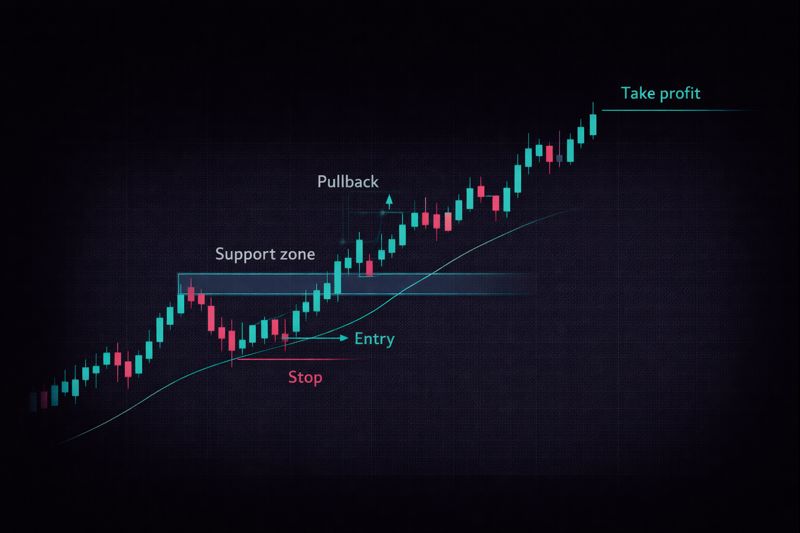
It works best when the market is clearly trending and pullbacks are clean rather than chaotic. Start by identifying the trend: higher highs/higher lows for an uptrend, or lower highs/lower lows for a downtrend. Then mark obvious swing points and wait for price to pull back into an area that previously acted as support or resistance.
For the entry, keep it beginner-simple: you’re looking for the pullback to stop and price to start moving with the trend again. One easy trigger is a break of the pullback’s mini structure—basically, price stops drifting against the trend and shows it’s ready to continue.
Stops should go where the idea is invalid. In an uptrend long, that’s usually below the pullback swing low. In a downtrend short, it’s usually above the pullback swing high.
For profits, choose one approach and stick to it. You can target the previous swing high/low, or take partial profit at 1R and aim the rest at 2R.
Common beginner mistakes (quick list):
- Entering before the pullback is actually finished
- Placing the stop inside normal noise
- Taking “trend pullbacks” when the market is really sideways
Strategy #2: Breakout + Retest
Most beginners lose money on breakouts because they chase the first candle. This version forces patience and dramatically improves quality.
It works best when price has been stuck in a tight range and then breaks out with real momentum—not just a tiny poke above a level. Your setup is simple: draw clear support and resistance, wait for the breakout, then wait for price to retest the breakout level.
Your entry only happens if the retest holds. That might look like price touching the level and rejecting back in the breakout direction, or forming a higher low for a long (or lower high for a short).
Stops go just beyond the retest swing point, because if price breaks that area, the retest failed and the setup is no longer valid.
Profit-taking can be as simple as targeting the next major level, or using 2R as your baseline target.
Beginner mistakes to avoid:
- Buying the first breakout candle
- Trading breakouts in dead conditions
- Ignoring fakeout signs when price dumps back into the range
Strategy #3: Opening Range Breakout
This strategy uses early-session volatility—when markets often choose a direction.
It tends to work best around major session opens like London or New York, especially when momentum shows up after the first range forms. Your setup is to define the first 15–30 minutes of the session as the “opening range” and mark its high and low.
A long trade triggers when price breaks above the opening range high and holds. A short triggers on the opposite side. As a beginner filter, skip trades when the opening range is unusually wide—if the range is huge, your stop often has to be huge too, which can destroy your risk-to-reward.
Stops can go on the opposite side of the opening range for simplicity, or behind the breakout structure for a tighter (but more fragile) stop. Profit-taking can follow a straightforward approach: take partial at 1R and trail the rest, or target the next major level.
Strategy #4: Range Trading
If the market is ranging, stop using trend strategies. Range trading is built for sideways action.
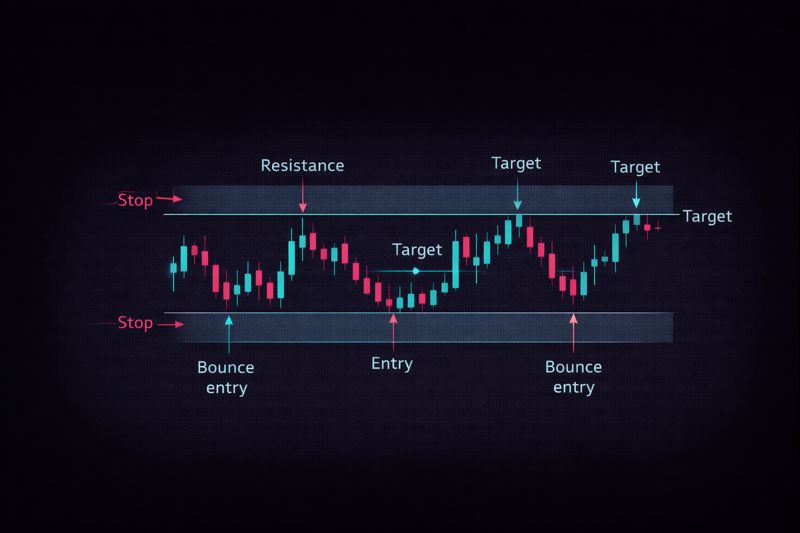
This works best when you have clear boundaries and repeated reactions at support and resistance. Start by marking the range and confirming you have at least two touches on each side. The goal is to trade near the edges, not the middle.
Entries come from rejection near support or resistance. For example, at support you might see price dip below and snap back up, showing buyers stepping in. Stops go just outside the range boundary—because if price breaks and holds beyond the boundary, the range thesis is invalid.
Profit-taking is easiest with a two-step approach: take partial at mid-range and aim the rest near the opposite boundary.
Strategy #5: Momentum Continuation (impulse → pause → go)
Momentum continuation is beginner-friendly because the pattern is clear: strong move, brief pause, continuation.
It works best on strong directional days when price makes a decisive impulse move, then consolidates tightly. Your setup is to identify that impulse and then wait for a compact consolidation where candles shrink and the range narrows.
The entry triggers when price breaks out of that consolidation in the direction of the impulse. Stops typically go on the opposite side of the consolidation, because that’s the area that should not break if momentum is real.
For profit-taking, you can target a measured move (projecting the impulse size) or keep it simple with a 2R baseline and a nearby key level.
Strategy #6: “Second Chance” Entry
Beginners chase because they feel they “missed it.” This strategy turns that problem into a plan.
It works best on trend days or breakout days when the first move happens fast, and then the market offers a pullback. Instead of jumping in late, you let the initial move go without you. Then you wait for the first reasonable pullback into a prior level, midpoint area, or consolidation zone.
Your entry triggers when the pullback clearly stalls and price starts moving back in the main direction. Stops go beyond the pullback swing point. Profit-taking often starts with a target back to the recent high/low, then extends to 2R+ if conditions allow.
A key rule: “Second chance” does not mean “tenth attempt.” Overtrading is the main way this strategy fails.
Strategy #7: Mean Reversion to Intraday Midpoint
Mean reversion is just the idea that price can snap back toward a “fair” area after overextending.
It works best on range days or after sharp spikes that fail to continue. The setup is to identify an overextension (a fast move away from balance) and mark a simple midpoint area, such as the middle of the day’s range so far or a prior consolidation zone.
Entries happen after the market shows failure—like a spike that immediately gets rejected or a quick move back below/above the level it just broke. Stops go beyond the extreme because if price returns to that extreme, the reversal thesis is likely wrong. Profits aim for the midpoint/balance area because it’s a realistic target.
The biggest beginner mistake is trying to fade strong trend days. Mean reversion can work, but not when the market is in “trend mode.”
The beginner “one-page trading plan”
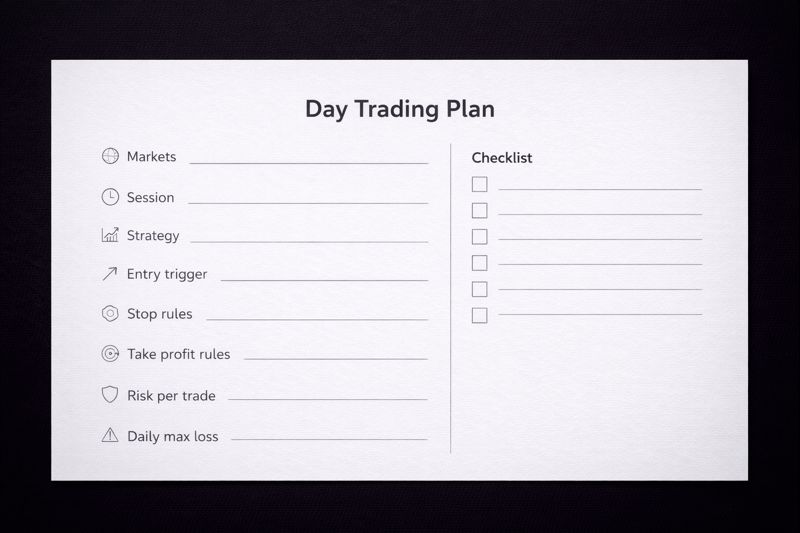
If you want consistency, you need a plan that fits on one page. The goal is not complexity—it’s clarity.
Your plan should make it obvious what you trade (markets and session), which 1–2 strategies you use, how much you risk per trade, where your daily max loss is, and what a valid setup looks like. If your plan is 14 pages, you won’t follow it. If it fits on one page, you might.
Risk management for beginners (the part that matters most)
Strategies are the fun part. Risk management is what keeps you in the game long enough to get good.
A solid beginner risk model is simple and consistent: risk 0.5% to 1% per trade, limit yourself to a manageable number of trades per day (3–5 is plenty), and stop trading once you’re down about 2R or after 2–3 losses. If you hit max loss multiple times in a week, reduce size or pause and review.
Before each trade, you want a short checklist—not a novel. Here’s the only checklist most beginners need:
- Does this strategy match today’s market (trend vs range vs volatility)?
- Do I know exactly where the stop goes?
- Does the chart realistically support at least ~1.5R reward?
- Am I calm—or trying to “get back” losses?
How to practice day trading strategies without blowing up
Beginners go live too early. Skill is built through reps, not hope.
A simple practice method is the 30-trade challenge: pick one strategy, run 30 trades on demo (or tiny size), screenshot each trade, and record your result in R. Add one sentence on what you did well and what you’d fix next time. After 30 trades, you’ll know whether the strategy fits you, what mistakes keep showing up, and whether your risk rules are realistic.
Improvement doesn’t look like doubling your account in a week. It looks like fewer impulsive trades, consistent stop placement, fewer revenge trades, and clean execution.
Common beginner mistakes and what to do instead
Most beginner errors come from five patterns. Overtrading is solved by a max trades-per-day rule. Moving stops is solved by accepting that being wrong is part of the game. Trading every market and every session is solved by specializing. Chasing candles is solved by using retests, pullbacks, and second-chance entries. And upsizing after a win is solved by scaling only after consistent results across a meaningful sample size—not one good day.
Where TradeLocker fits
A beginner doesn’t need “more features.” They need fewer mistakes.
TradeLocker’s value here is that it helps you turn strategy rules into consistent execution. When you can place entries, stops, and targets quickly and clearly—and size positions mechanically—you reduce the most common beginner errors: hesitation, chasing, and emotional sizing. The goal is simple: make your process repeatable. Your platform should support that, not fight it.
FAQ
How many strategies should a beginner learn?
Start with one. Add a second only after you’ve logged real reps and results.
What’s the best timeframe for beginner day trading?
Use 1H for direction and 5m/15m for entries. Ultra-low timeframes are noisy and stressful.
Can beginners scalp?
They can, but it’s harder. Scalping magnifies costs and speed. Most beginners do better with pullbacks, ranges, or breakout + retest.
How much should I risk per trade?
0.5% to 1% is a solid beginner guardrail. Lower is fine if it helps you stay consistent.
Conclusion
If you’re new to day trading, your mission isn’t to find the perfect strategy. Your mission is to pick one beginner-friendly playbook, apply consistent risk rules, and get enough reps that execution becomes automatic.
Start with trend pullbacks on trend days, range trades on range days, and breakout + retest setups on transition days. Then run the 30-trade challenge. That’s how you get good—without getting wrecked.
Disclaimer: This article is educational and not financial advice.
