If trading feels like this…
You’re calm, you’re patient, you’re following your “strategy” and then the market moves fast.
Suddenly you’re not following anything.
You enter late. You move the stop “just a bit.” You size up because the setup looks perfect. You take another trade right after a loss because you want it back. You know it’s not ideal… but in the moment, it feels justified.
That’s the real reason most traders struggle: their decisions change under pressure.
A trading plan is how you keep your decisions consistent when the market tries to pull you into chaos. And no, a trading plan doesn’t need to be complicated. In fact, the best plans are usually simple enough to fit on one page.
In this guide, you’ll learn:
- What a trading plan actually is (and what it isn’t)
- The parts every solid plan must include
- A one-page template you can copy and use today
- Three realistic trading plan examples (day trading, swing trading, and risk-first)
- How to follow your plan when emotions show up (because they will)
Along the way, I’ll also include image ideas with detailed prompts you can use to generate visuals for the post.
The simple definition: what is a trading plan?
A trading plan is a written framework for making trading decisions.
Not a prediction. Not a wishlist. Not a vague promise to be disciplined.
A real trading plan answers the questions that matter before you enter a trade:
What do I trade?
When do I enter?
Where am I wrong?
How much do I risk?
Where do I take profit?
When do I step aside?
How do I review results and improve?
That’s it.
Think of your plan as the “operating system” behind your trades. It turns trading from an emotional activity (“I think this will go up”) into a repeatable process (“My conditions are met; I execute my rules”).
Here’s the key idea that most traders miss:
A trading plan is not designed to make you feel confident.
It’s designed to make your decisions consistent.
Because consistency is what allows you to learn. And learning is what compounds.
When traders don’t have a plan, they can’t tell the difference between:
- a strategy problem (their setup isn’t good),
- a process problem (they don’t follow the rules),
- or a risk problem (they size too big and can’t handle normal losses).
A plan makes those problems visible.
What a trading plan is NOT and why that matters
A lot of traders think they have a plan, but what they have is one of these:
They have a strategy (“I trade breakouts”), but no rules for risk, limits, or review. They have indicators, but no decision framework. They have goals (“I want to make 10% this month”), but no process for how to behave when they’re down 2% in a day. They have a document that looks serious… but it’s too complicated to follow in real time.
So let’s draw a clean line.
A trading plan is not a guarantee that you’ll make money.
It’s a set of rules that protect you from your worst decisions, especially the ones you make when you feel urgency.
Most trading losses aren’t caused by “one bad trade.” They’re caused by a chain reaction:
- small loss,
- impulse trade,
- oversize,
- moved stop,
- bigger loss,
- revenge trade,
- blown day.
A plan is how you stop the chain reaction early, while the damage is still small. That’s why the best traders don’t treat plans as paperwork. They treat plans as protection.
Trading plan vs strategy vs checklist vs journal
This confusion is common — and expensive.
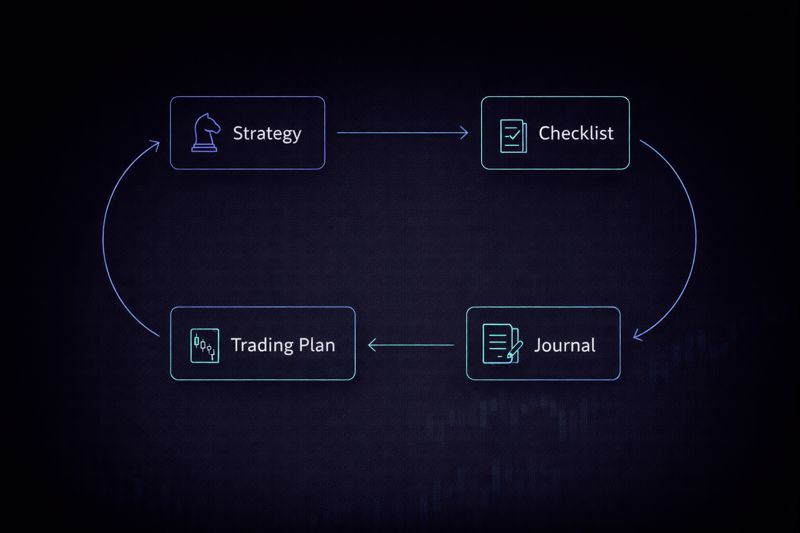
A strategy is how you find trades. It’s your setup logic.
A trading plan is bigger. It includes the strategy, but it also includes risk rules, position sizing, daily limits, routines, and review.
A checklist is the quick filter you run right before entry. It prevents “almost qualifies” trades.
A journal is what you record after the trade so you can improve without guessing.
If you want a mental model that sticks, use this:
Your strategy finds the opportunity.
Your checklist confirms it’s valid.
Your plan executes it with controlled risk.
Your journal improves the whole system over time.
If your results feel random, this section is often the missing piece: most traders keep changing strategies when the real problem is that they don’t have a plan that controls risk and behavior.
Why you need a trading plan
Let’s be honest: analysis is the fun part. Planning your risk limits isn’t fun.
Writing down “If I hit my daily loss limit, I stop” isn’t fun.
But those “unsexy” rules are often what separates traders who stay in the game from traders who keep restarting from zero. Because trading is not only about finding good entries.
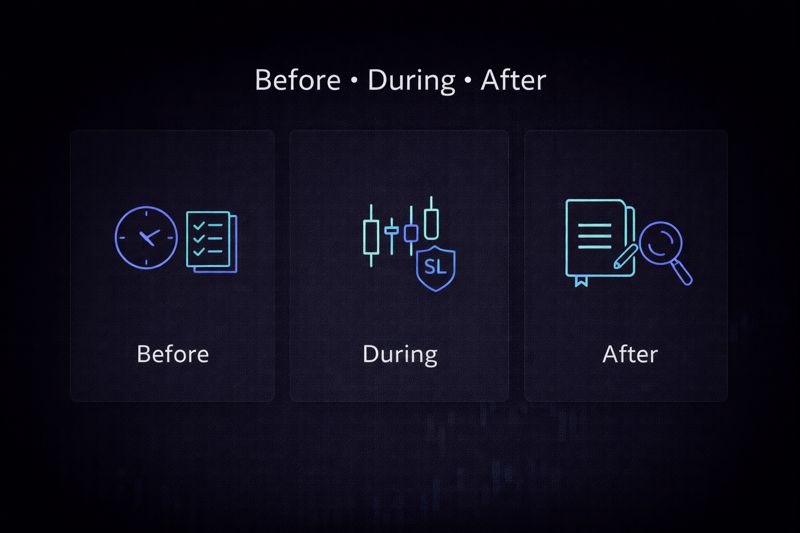
It’s about managing yourself in three moments:
Before the trade: You’re tempted to enter early because you don’t want to miss it.
During the trade: You’re tempted to interfere because price is moving and you want certainty.
After the trade: You’re tempted to trade again immediately because you want emotional relief.
A trading plan exists for those moments.
It protects you from:
- Trading when you shouldn’t be trading
- Taking trades that don’t actually meet your standards
- Sizing based on emotion
- Turning one loss into five losses
And it does something else that’s even more important long-term:
It gives you a clean feedback loop. If you don’t have written rules, you can’t review anything. All you can do is feel. A plan turns feelings into data.
What to include in a great trading plan
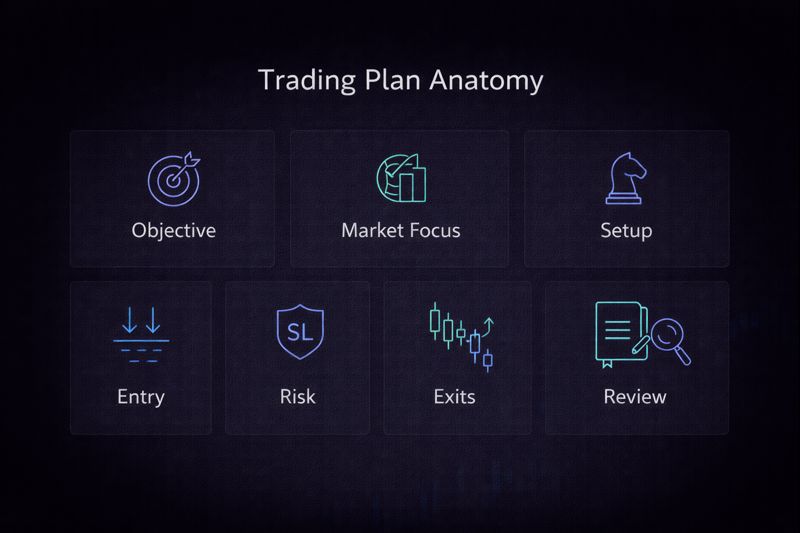
A strong trading plan isn’t long. It’s complete. It covers seven areas. I’m going to explain each one in a way that helps you actually write it, not just understand it.
Your objective (what you’re optimizing for)
Most traders write objectives like “make money” or “be consistent.”
That’s a start, but it doesn’t tell you what to do on Tuesday at 10:14 AM when you’re down on the day and a mediocre setup appears. A useful objective is behavioral and measurable.
It’s something like:
You’re optimizing for high-quality execution, controlled risk, and rule-following. Because if you can do those three things, profits become a byproduct over time.
Try writing an objective like this: “I will execute my rules with fixed risk for the next 30 trades. My goal is to reduce rule violations to near zero.”
That objective will change your trading more than any new indicator.
What you trade and when you trade it
If your plan doesn’t define what you trade, you’ll trade whatever is moving. And “whatever is moving” is a trap.
Your plan should define:
- the instruments you focus on,
- the time windows you trade,
- and the conditions that automatically disqualify trades.
This isn’t about limiting opportunity. It’s about reducing noise so you can get better faster. If you’re trading forex, that could mean focusing on a small set of pairs and a specific session. If you’re day trading indices, it could mean specific market hours only. The key is that you’re making a deliberate choice, not reacting to randomness.
Your setup
A setup should be explainable without charts. If you can’t describe it clearly, you will interpret it differently depending on your mood.
A good setup description includes:
- the context (what must be true in the market),
- the condition (what you are waiting for),
- and the trigger (what makes you act).
Your goal isn’t to write a novel. Your goal is to write something you can follow the same way on a calm day and a stressful day.
Your entry rule
This is where many plans fall apart.
Entry rules are often written like this: “I enter when it looks strong.”
That’s not a rule. That’s a feeling. A rule is something you can answer “yes” or “no” to. A good entry rule makes it harder to enter — not easier. Because your biggest losses rarely come from missing great trades. They come from taking average trades with full risk.
Your risk rules
If your risk rules are loose, your plan is loose. And if your plan is loose, your emotions will fill the gap.
At minimum, your plan should define:
- risk per trade,
- max daily loss,
- max weekly loss,
- and how much total risk you can have open at once.
Why? Because markets can be random in the short term. You can do everything right and still lose. That’s normal. The plan’s job is to make sure normal losses don’t become catastrophic losses.
Your exits
Exits are where the plan becomes real. If your stop loss isn’t based on invalidation, you’ll move it. If your take profit isn’t pre-defined, you’ll grab profits early (or hold too long). A plan doesn’t need complex exits. It needs consistent exits. Choose a simple take-profit approach you can repeat, and write it down.
Your review routine
If you don’t review, your plan is static. Static plans don’t survive real trading. Your review doesn’t need to be complicated. It needs to be regular.
A short weekly review is often enough:
What did I do well?
What rules did I break?
What pattern is repeating?
What will I change next week (one thing)?
Notice the focus: process first, not emotion.
The one-page trading plan template
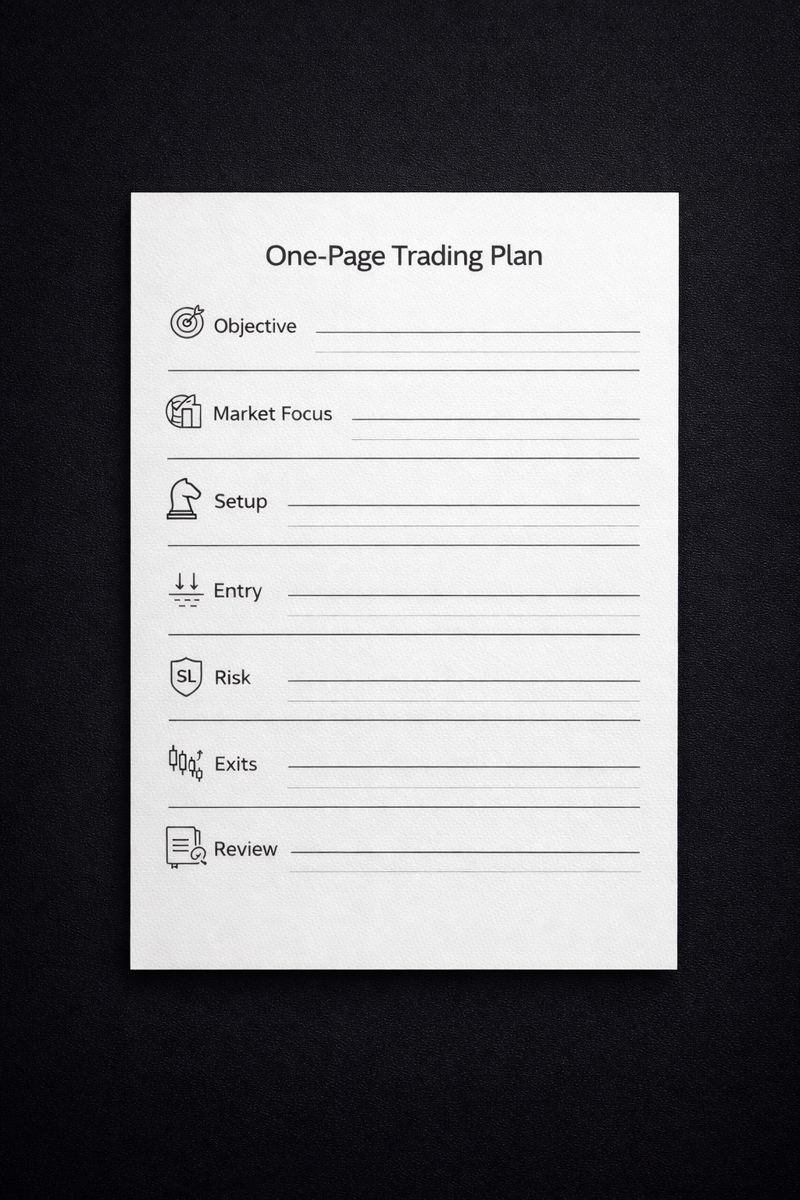
Here’s a template that’s intentionally simple.
If your current “plan” feels messy, start here. You can always expand later — but you can’t follow what you never wrote down.
Trading Plan (One Page)
My objective (behavior + timeframe): ______
Markets/instruments I trade: ______
Time window (days/times): ______
My setup in one paragraph: ______
My entry trigger (yes/no rule): ______
Stop loss rule (invalidation point): ______
Take profit rule (simple + repeatable): ______
Risk per trade: ______
Max daily loss: ______
Max weekly loss: ______
Max open risk: ______
No-trade conditions (when I do nothing): ______
Post-trade notes (3 fields only): ______
Weekly review time: ______
There’s one line in that template that quietly changes everything:
No-trade conditions.
Most traders write rules for when they trade. Very few write rules for when they don’t trade. But “do nothing” is a profitable skill in trading. And it belongs in the plan.
Three trading plan examples you can copy
A lot of “examples” online are either too vague to use or too complex to follow. So here are three examples that are intentionally practical. They’re not magical strategies. They are complete plans with risk limits, behavior rules, and review structure — the parts that make a plan work in real life.
Example 1: A simple day trading plan
This plan fits traders who want structure and fast feedback. The goal isn’t to trade all day. The goal is to trade during a defined window when you’re focused.
In this plan, you focus on one or two instruments only. You trade during a specific session. You do not “scan the whole market” looking for action. You wait for your setup.
The setup itself is simple: you’re trading a clean, obvious move that meets your requirements. Your entry trigger is written as a rule you can’t talk yourself out of.
Your stop loss is placed where your idea is wrong. Not where it “feels safe.” If the trade needs a stop that doesn’t fit your risk, you don’t adjust the plan — you skip the trade.
Your profit-taking rule is intentionally boring. You pick one method you can repeat and you stick with it long enough to evaluate it honestly.
And this plan includes something most day traders avoid: an “off switch.” A hard max daily loss and a maximum number of trades. That’s what prevents a normal losing day from turning into a mess.
If you adopt nothing else from this example, adopt the idea that a day trader’s edge often comes from what they don’t trade.
Minimal checklist (kept short on purpose):
- Is this my setup, or is it “close enough”?
- Is my stop based on invalidation?
- Is my size fixed to my risk rule?
- Am I within my daily limits?
Example 2: A swing trading plan
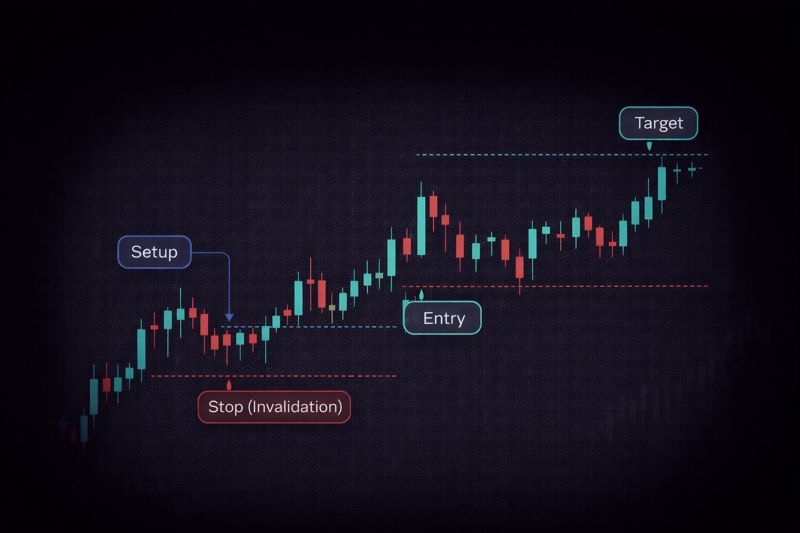
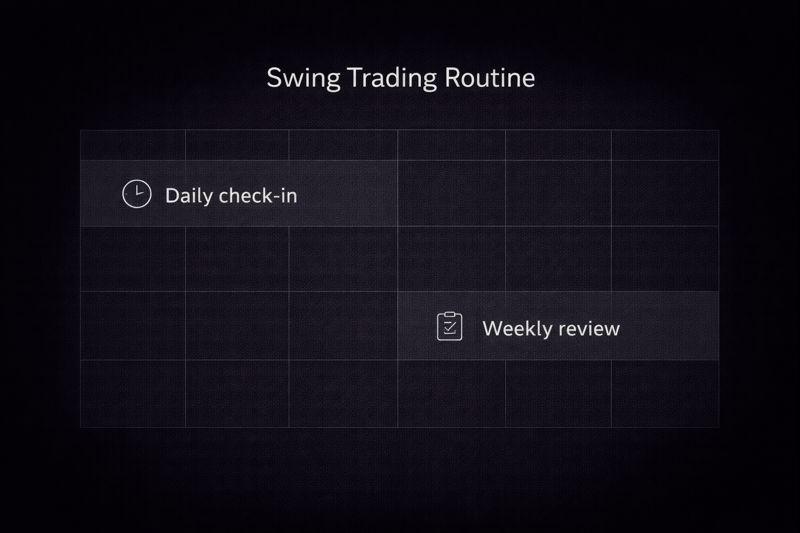
This plan fits traders who don’t want constant decision-making. You check the market at set times. You don’t get pulled into every move.
Swing trading is where many traders accidentally sabotage themselves by acting like day traders. They over-manage. They watch every candle. They move stops because of noise.
So this plan solves that with one principle: reduce decision points.
You define the market conditions you trade. You define your setup in one paragraph. You define an entry trigger you can follow. And then you define how often you’re allowed to interfere.
That last part matters.
If you’re swing trading, your plan should say something like:
“I review positions once per day at a consistent time unless price hits my stop or target.”
That rule alone eliminates a huge chunk of emotional interference.
Risk rules matter even more on swings because stops can be wider, and holding through pullbacks is psychologically harder. A fixed risk-per-trade rule keeps you from scaling up because you “feel more confident.”
The review process stays simple: you’re looking for whether your setup and execution are consistent. You’re not trying to engineer perfection after every trade.
Example 3: A risk-first plan
This plan fits traders who want to make risk control the main edge.
It’s especially useful if you’ve ever experienced a “good week ruined by one day.” That pattern is usually not a strategy problem. It’s a risk and behavior problem.
A risk-first plan treats daily and weekly loss limits as non-negotiable. It treats position sizing as a fixed rule. It treats “cooldown after losses” as part of the plan, not a suggestion.
This plan also sets a high bar for trade quality.
Instead of trying to trade often, you aim to trade only when conditions are clean and obvious. That reduces the number of decisions you have to make — and fewer decisions means fewer chances to break rules.
The journal focus is different too. Your main metric isn’t P&L. Your main metric is rule compliance.
Because profits can be noisy in the short term. Rule violations are not.
If you want to build trust in yourself as a trader, this is a strong template. It creates stability first. Then you expand.
How to actually follow your plan when emotions show up
Writing a plan is the easy part.
Following it is where trading becomes real.
Most traders don’t break their plan because they’re careless. They break it because they’re trying to reduce discomfort. They want certainty. They want the trade to work. They want to feel “in control.”
A plan helps — but you also need a few pressure-proofing rules that make plan-following more likely.
One of the most effective techniques is writing rules in “if/then” language. It’s not about being robotic. It’s about removing negotiation.
“If I hit my daily loss limit, then I stop.”
“If I miss my entry trigger, then I do not chase.”
“If I break a rule, then I pause and write a note before the next trade.”
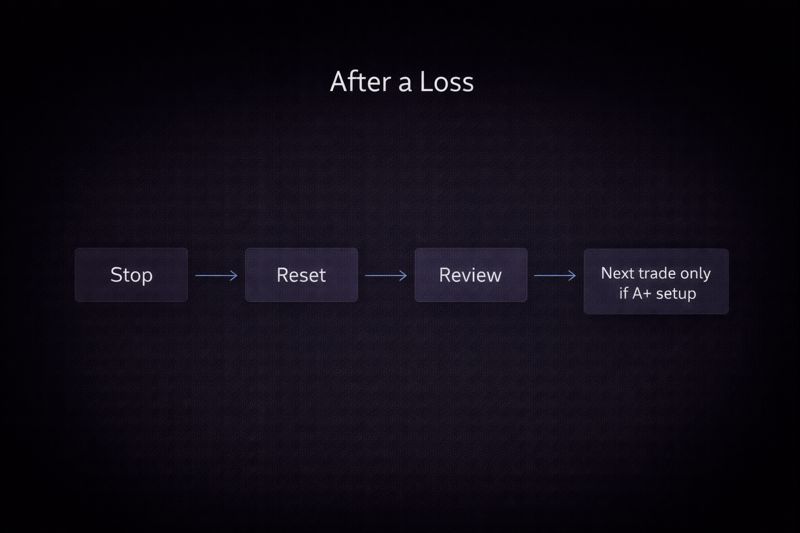
Notice what that does: it prevents the spiral. Another practical tool is keeping a pre-trade check so short that you actually use it. If your checklist takes two minutes, you’ll skip it. If it takes ten seconds, you’ll use it. And finally, you need a simple “reset” protocol for when you feel impulsive. Not a motivational speech. A protocol.
Step away from the screen. Write one sentence: “Which rule am I tempted to break?”
If you can’t answer, you don’t trade.
It’s surprisingly effective because it forces a pause between impulse and action.

Reviewing your plan
A trading plan should evolve. But it should evolve deliberately, not emotionally. Here’s a common trap: a trader has a losing day and immediately changes the plan. Then they never learn whether the plan was solid or whether they simply experienced normal randomness. Your review process should protect you from that.
A good weekly review is simple. You’re looking for a small set of things:
Did I follow my rules?
Where did I break them?
What pattern is repeating?
What is the single best improvement to focus on next week?
It’s tempting to focus on wins and losses, but process is the faster path to improvement. Wins can hide mistakes. Losses can be perfectly executed. The review needs to separate those.
A useful way to do this is to tag each trade with two labels:
- Setup quality (high / medium / low)
- Rule compliance (yes / no)
Over time, that shows you what’s really happening:
Are you losing because the setup is weak?
Or are you losing because you’re taking too many low-quality trades?
Or are you losing because you keep breaking one specific rule?
That’s how a plan turns trading into a skill, not a guessing game.
Where TradeLocker fits
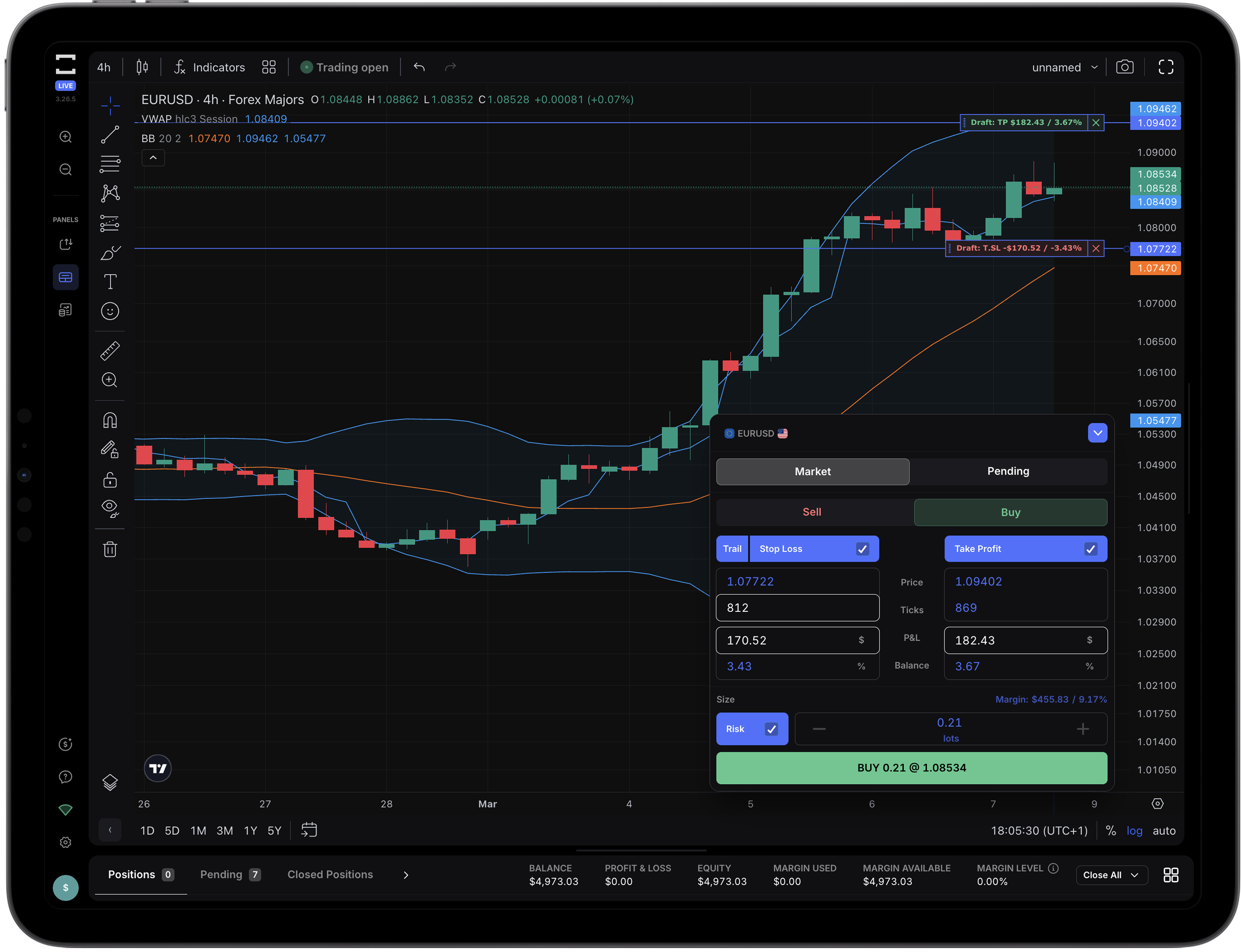
A trading plan lives or dies in execution. If execution is clunky, slow, or confusing, it becomes harder to follow your rules under pressure. That’s where your platform matters — not as a shortcut, but as support.
A plan-friendly workflow is one where you can:
- define risk clearly before entering,
- place stop loss and take profit without friction,
- and review trades cleanly after the fact.
TradeLocker is naturally positioned here because it’s built around streamlined execution and clear risk workflows on chart. The best way to mention it in this post is not as a big “pitch,” but as a quiet implementation layer: “Here’s the plan; here’s how you execute the plan cleanly.”
Common mistakes that ruin trading plans and how to avoid them
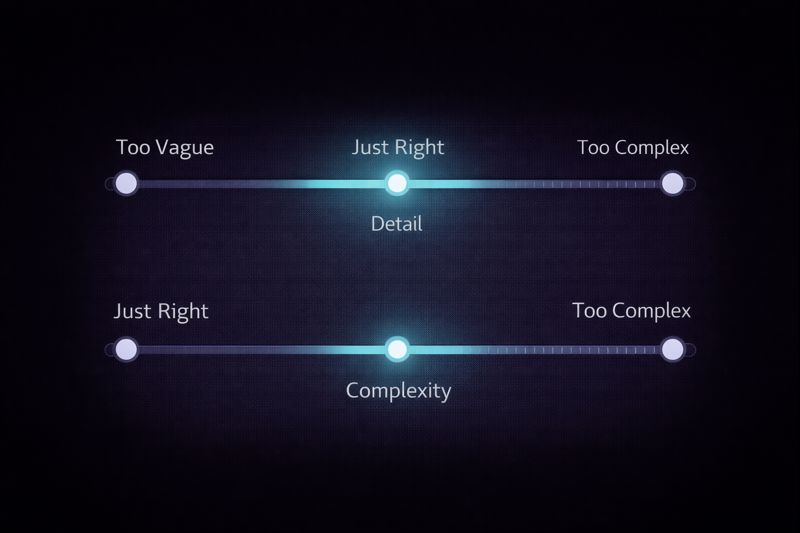
Most trading plans fail for one of two reasons: They’re too vague to follow, or too complex to use. Vague plans sound like: “I trade breakouts with good risk management.” That gives you nothing to execute. Overly complex plans sound like: 17 conditions, multiple exceptions, and a decision tree you can’t use in real time. Complexity feels safe. But it often leads to confusion — and confusion leads to improvisation.
A good plan is clear enough that you can apply it while you’re slightly stressed. Another common mistake is changing the plan too often. If you adjust your rules after every losing streak, you’ll never build clean data. You’ll always be in “trial mode.”
A better approach is to set a testing window. For example:
“I will follow this plan for the next 30 trades without changing core rules. Then I’ll review and adjust one variable.”
That creates stability. And stability creates progress.
Conclusion
A trading plan won’t eliminate losses.
What it will do is eliminate many of the losses that come from avoidable behavior: chasing, oversizing, moving stops, trading when you shouldn’t.
It turns trading into a process you can refine.
If you do one thing after reading this, do this:
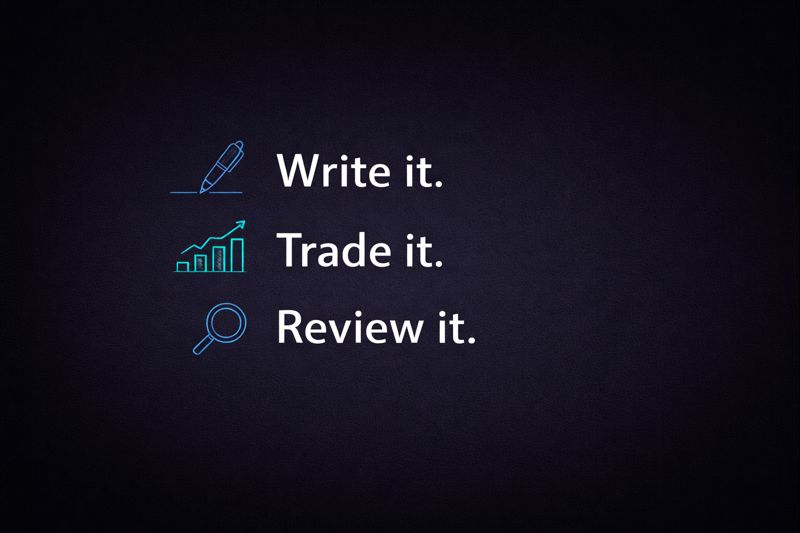
Write a one-page plan, keep risk fixed, and follow it long enough to learn from it.
That’s how you build consistency that compounds.
Disclaimer: This article is educational and not financial advice.
