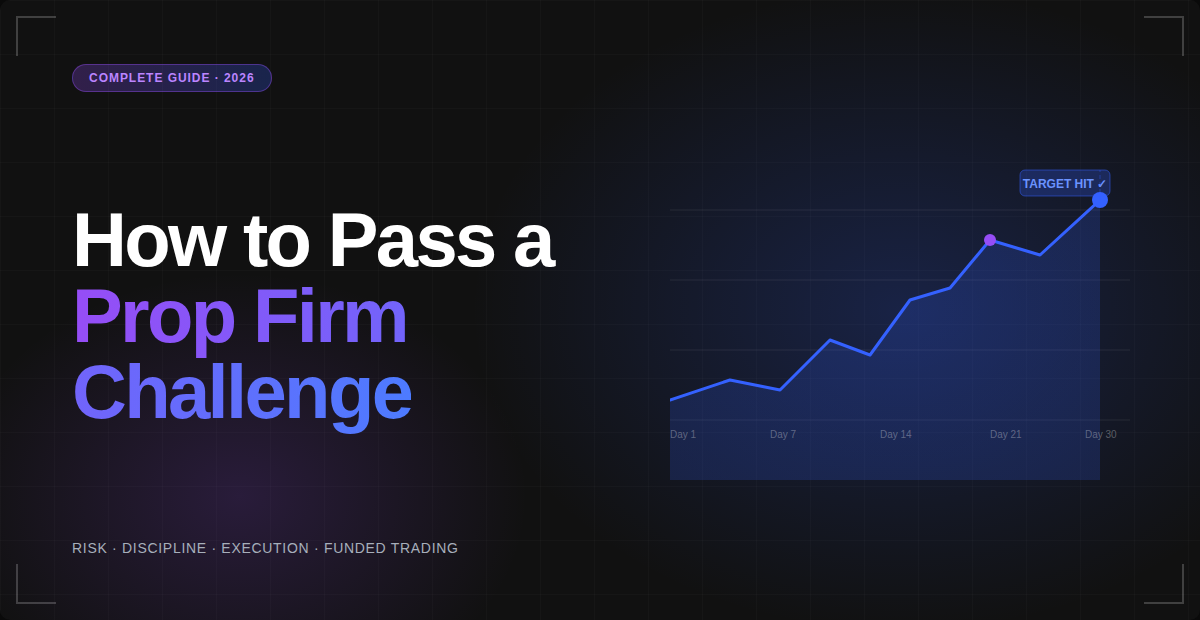
Passing a prop firm challenge means hitting a profit target within a set of strict rules without breaching your drawdown limits consistently enough that a firm trusts you with their capital.
Most traders who fail don’t fail because they can’t trade.
They fail because they oversize one position, break a rule they didn’t fully understand, or let one bad session spiral into something they can’t recover from.
This guide covers what actually separates traders who pass from traders who don’t, and walks you through the mindset, habits, and process you need to give yourself the best possible chance.
What a prop firm challenge actually tests
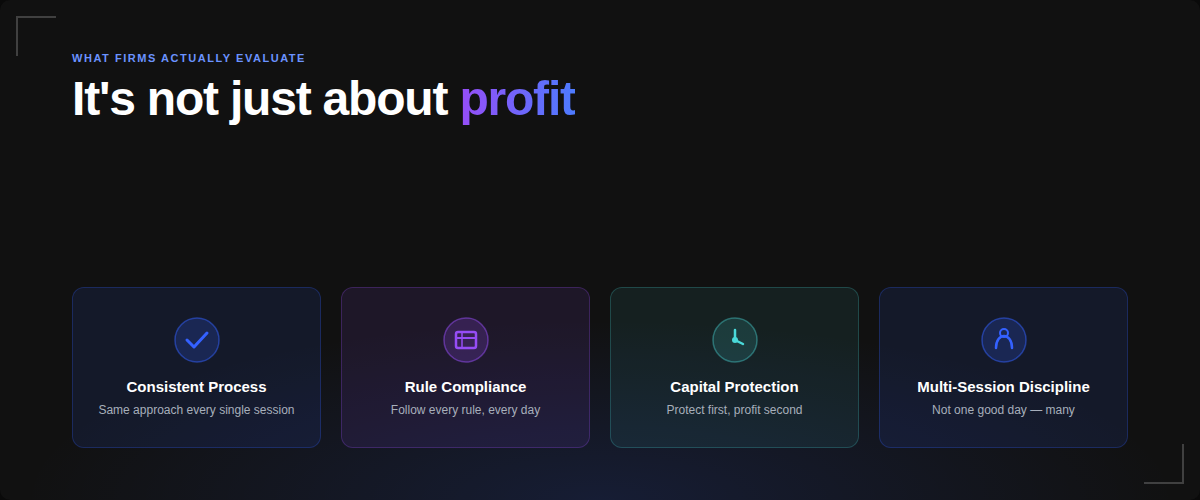
A common misconception is that challenges are designed to test how profitable you are. They’re not. At least not in the way most people think.
What a challenge actually tests is whether you can:
– Execute a consistent process under pressure
– Follow a defined set of rules when real consequences are attached
– Protect capital first, generate returns second
– Stay disciplined across multiple sessions, not just one or two good days
Think of it this way: the profit target is the floor, not the ceiling. Getting to the target recklessly by overleveraging or getting lucky on a few trades won’t serve you once you’re funded. Firms know this, which is why they’ve designed the challenge to filter for process, not just outcome.
That shift in framing changes everything about how you should approach the challenge.
Why most traders fail prop firm challenges
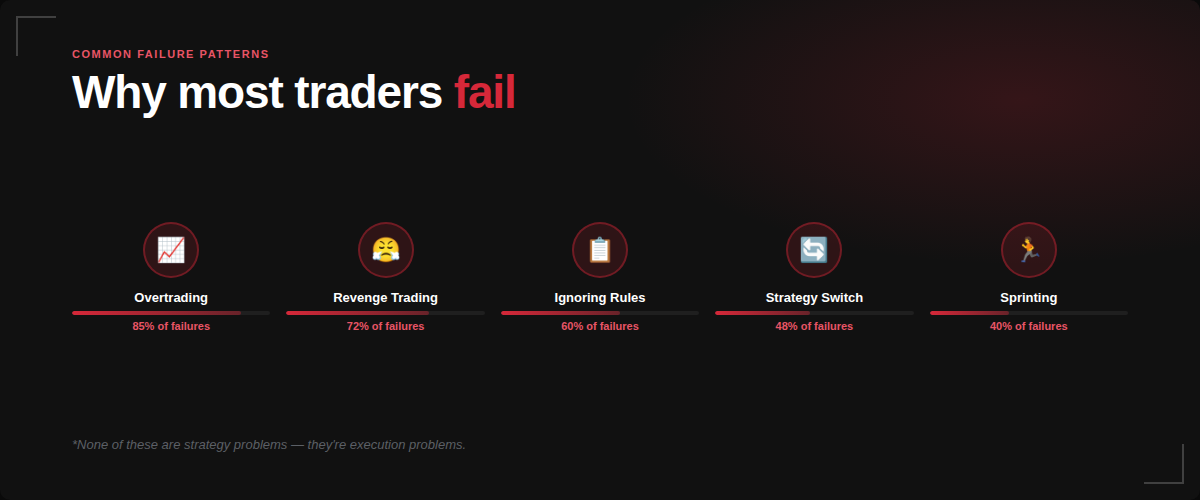
Before getting into what works, it helps to understand what goes wrong because most failures follow the same patterns.
Overtrading is the most common. Traders take setups that don’t fully meet their criteria, trade out of boredom, or feel like they need to “do something” to make progress toward the target. The result is a string of marginal trades that erode the account without ever providing real edge.
Revenge trading is close behind. One losing trade leads to another, then another, all taken to “get the money back.” Revenge trading is almost never done according to plan. It’s done according to emotion. And it’s one of the fastest ways to hit a daily drawdown limit.
Ignoring or misunderstanding the rules happens more than people admit. Traders don’t track their daily loss in real time, miss a rule about minimum trading days, or don’t realize a certain instrument is restricted during news windows. Failing on a technicality after weeks of solid trading is devastating and completely avoidable.
Switching strategies mid-challenge is a confidence problem that shows up as a process problem. When a few trades don’t go as expected, traders abandon the approach that brought them to the challenge in the first place and start testing something new. That never ends well.
Treating the challenge like a sprint is a framing problem. Challenges are designed to run over multiple weeks. Traders who try to hit the profit target in the first three days almost always take on too much risk to do it, which puts them in a hole they can’t climb out of.
None of these are strategy problems. They’re execution and discipline problems. That’s important because it means they’re fixable.
Know the rules before you place a single trade
This sounds obvious. It isn’t.
Most traders skim the rules when they sign up, start trading, and only go back to re-read them when something goes wrong. By then, the damage is done.
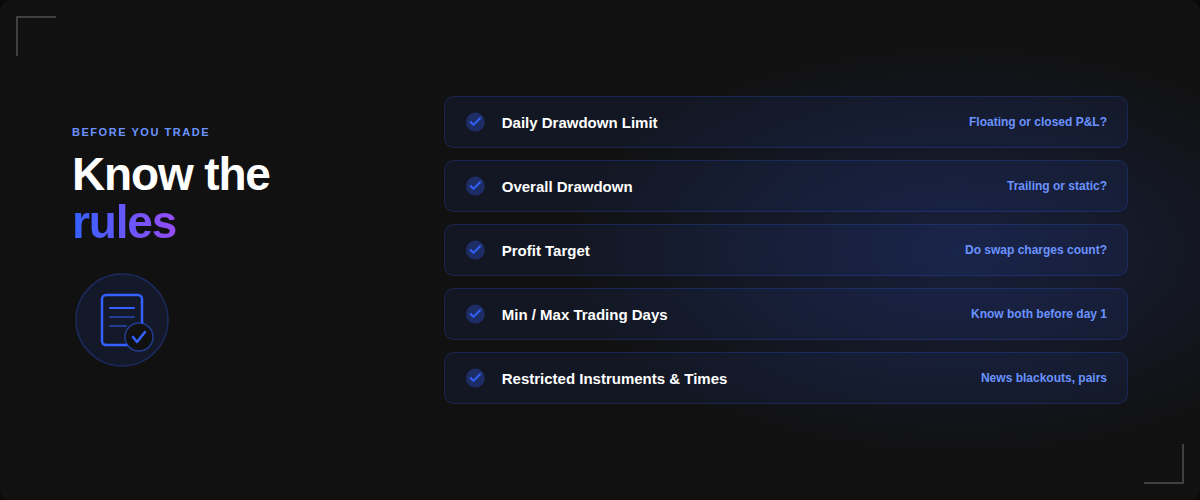
Before you open a position on your challenge account, you need to understand every rule, not just the main ones.
Daily drawdown limit: How much can you lose in a single day before the account is breached? Is it calculated from the open of the day, from the session high, or from midnight? Is it based on floating P&L or closed P&L? The calculation method matters more than most traders realize.
Overall drawdown limit: What’s the maximum total loss allowed? Is it trailing (adjusts as your account grows) or static (fixed from the starting balance)? A trailing drawdown is significantly more restrictive than it looks, because a few winning trades can raise the high-water mark and the floor moves with it.
Profit target: What percentage gain do you need to pass? Do partial closures count? Do swap charges affect the calculation?
Minimum and maximum trading days: Some firms require you to trade for a minimum number of days to prove consistency. Others have a hard time limit. Know both.
Restricted instruments, times, or conditions: Many firms ban trading through high-impact news events. Some restrict certain pairs. Some have rules around holding trades over the weekend. If you don’t know these, you’re trading blind.
The only right time to read the rules is before you start. Set aside 30 minutes. Take notes. If anything is unclear, contact the firm’s support before you trade.
Build a risk framework and stick to it
Risk management is what keeps you in the challenge long enough for your edge to play out. Without it, even a good strategy can blow the account.
Here’s a simple framework that works for most challenge accounts:
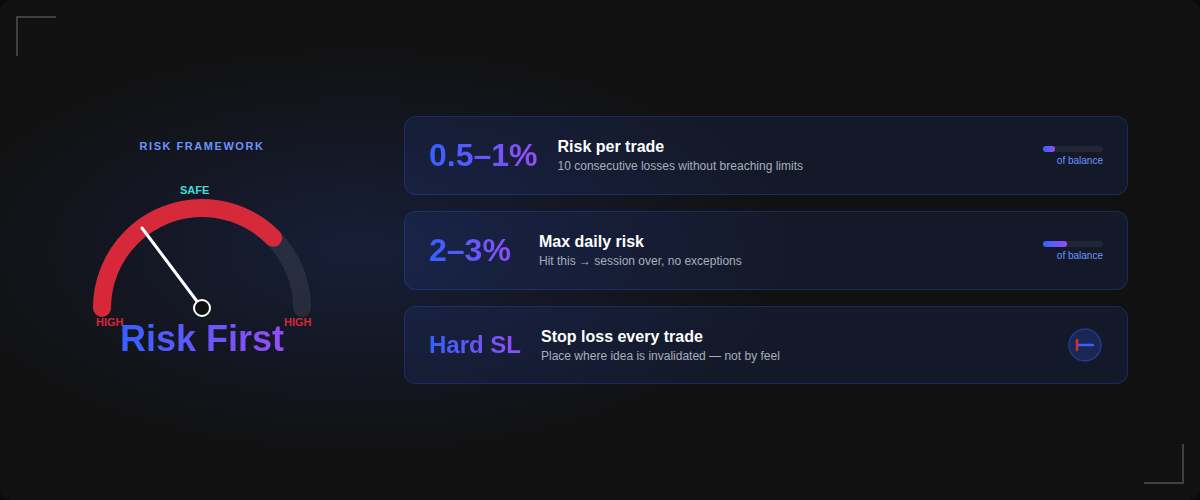
Risk 0.5% to 1% per trade. This gives you enough room to string together multiple losing trades without approaching your drawdown limits. At 1% risk per trade, you can lose ten trades in a row and still be within most firms’ overall drawdown limits. That’s not a consolation prize, that’s the point. Survival is the priority.
Cap your daily risk at 2% to 3%. Once you’ve hit that threshold, stop trading for the day. No exceptions. Respecting the daily cap prevents one bad session from becoming a catastrophic one, and it trains you to accept that not every day will be profitable.
Use a hard stop loss on every single trade. “I’ll watch it manually” is how accounts get blown. The market can move faster than you can react, especially during news spikes or session opens. Every trade gets a stop, placed at the point where the idea is invalidated, not at a round number you picked because it “felt right.”
Size from the stop loss, not the other way around. Decide how much you’re risking first. Place the stop where it makes sense technically. Then calculate the position size that makes the distance to the stop equal your intended risk. This is the “risk-first” approach, and it’s the most disciplined way to size any trade.
TradeLocker’s risk calculator is built around this workflow. You can set your stop loss in ticks, price, or percentage, and it will calculate the correct position size based on the amount you’re willing to risk. That removes the mental math from the moment you’re placing a trade, which reduces mistakes and keeps your risk consistent across every session.
Trade only your best setups
A prop firm challenge is not the place to experiment. It’s not a sandbox for learning new strategies or testing ideas you’ve been curious about. You have a defined window, limited drawdown buffer, and real consequences if you breach the rules.
Trade the setups you know inside out. The ones you’ve seen hundreds of times. The ones you can explain in two sentences.
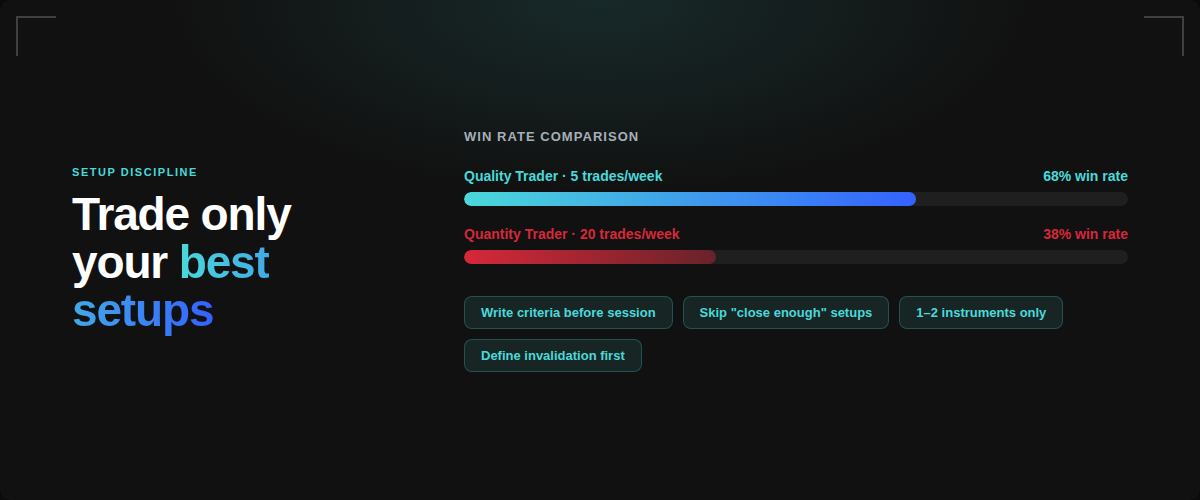
Write down your entry criteria before the session starts. What does a valid setup look like? What needs to be true before you consider entering? What’s the invalidation — the thing that proves you’re wrong? If you can’t answer those questions before the market opens, you shouldn’t be trading that session.
Skip trades that are “close enough.” If you have to talk yourself into a trade, skip it. “Close enough” setups almost never perform as well as clean setups, and the cognitive load of managing a trade you weren’t fully confident in creates pressure that leads to poor decisions downstream.
Focus on one or two instruments. Trading 15 different pairs spreads your attention and makes your results harder to diagnose. When you focus on one or two instruments, you start to understand their behavior at a level that genuinely improves your execution, how they move around key levels, how they react to session opens, what false breaks tend to look like on that specific instrument.
Quality over quantity wins challenges. A trader who takes five high-conviction trades per week will almost always outperform someone grinding twenty marginal ones. The goal is a clean track record that proves you have an edge, not a high trade count.
Understand drawdown management in real time
Knowing your drawdown limits on paper is not the same as actively managing against them in real time. Many traders fail because they lose track of where their daily or total loss stands during a live session.
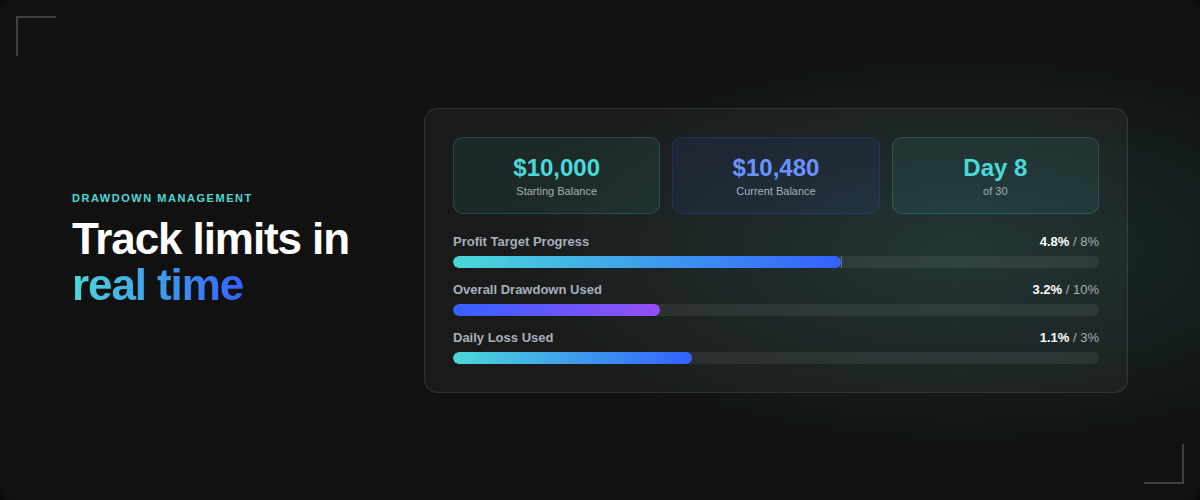
Track your P&L against your limits as you trade. Before each session, know exactly:
– Where your overall drawdown limit stands today
– What your daily loss limit is and how much buffer you have left
– Whether any open positions are at risk of hitting those limits before you’d reach your stop
This sounds administrative. It is. But it’s the kind of administration that prevents you from reaching your stop loss on three trades simultaneously and suddenly finding you’ve breached the daily limit without realizing it.
Build a simple reference sheet. Starting balance, daily drawdown limit in absolute dollar terms, overall drawdown limit in absolute dollar terms, current balance, today’s P&L. Update it at the start of each session. Keep it visible while you trade.
When in doubt, reduce size, not just stop trading. If you’re close to your daily limit but see a setup you genuinely want to take, consider halving your risk on that trade rather than either skipping it entirely or taking it at full size. That keeps you in the game while protecting the floor.
Build a daily routine you can repeat
Consistency is what firms are evaluating. Not a single brilliant day, a repeatable process across the entire evaluation window.
The traders who pass most reliably aren’t the ones with the most creative strategies. They’re the ones who show up with the same process every single day, execute it cleanly, and don’t deviate when things get uncomfortable.
A simple structure that works:
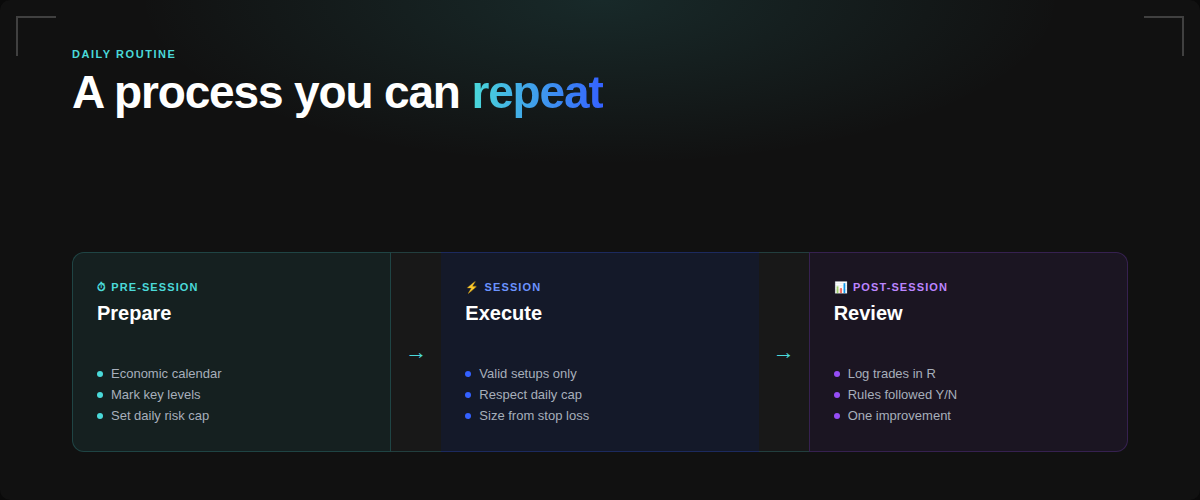
Pre-session (10–15 minutes):
Check the economic calendar and note any high-impact events during your trading window. Mark key levels on your charts. Define your directional bias and what would change it. Confirm your remaining drawdown buffer and set your daily risk cap for the session.
During the session:
Only trade when your setup criteria are fully met. Respect your daily risk cap when it’s hit, the session is over. Stay off the platform if you’re feeling emotional or distracted.
Post-session (5–10 minutes):
Log every trade. Note the setup name, whether the entry met all criteria, the result in R (not just dollars), and whether you followed your rules. That last field “rules followed: yes/no” is the single fastest way to identify where your process is breaking down.
This routine doesn’t need to be elaborate. What matters is that you do it every day, without exception. Discipline in the routine builds discipline in the trading.
Handle high-impact news carefully
News releases, Non-Farm Payrolls, CPI, central bank rate decisions can spike volatility in seconds. Spreads widen, liquidity drops, and price can move 50–100 pips instantly. Stop losses get filled at worse prices. Accounts get breached in situations where they should have been fine.
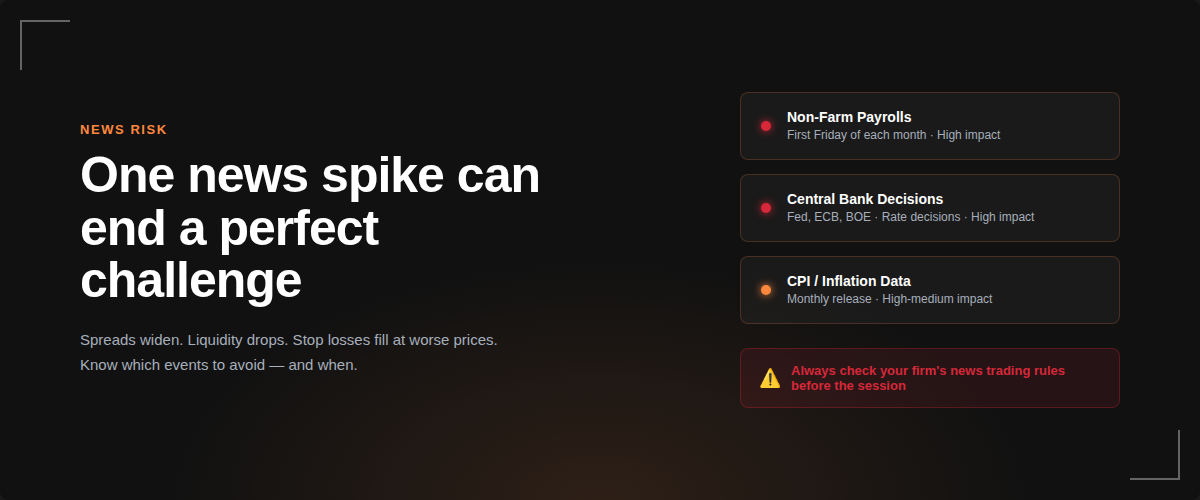
For traders in a challenge, news events carry extra risk because:
– Volatility spikes can trigger daily drawdown limits even if price eventually reverses
– Some firms explicitly ban trading through major news events — a violation means automatic failure
– The unpredictability of news makes it very difficult to size positions correctly
Check your firm’s rules on news trading first. Some firms ban holding positions through specific events (usually marked as high-impact on the economic calendar). Others allow it but warn about execution risks. Know exactly where your firm stands.
If news trading is allowed but not part of your strategy, avoid it anyway. There’s no edge in taking a position just because a big number is coming out. Wait for the dust to settle and trade the post-news structure if your setup criteria are met.
Use an economic calendar every morning. Note what’s coming out, when, and how high-impact it is. Build your session plan around it, knowing in advance that you won’t trade during a certain window removes the temptation to make exceptions in the moment.
Manage your psychology across the full challenge
The challenge phase can feel higher stakes than regular trading because the consequences are clear and immediate. That pressure amplifies every emotion and emotional trading is almost always worse than calm trading.
A few things that genuinely help:
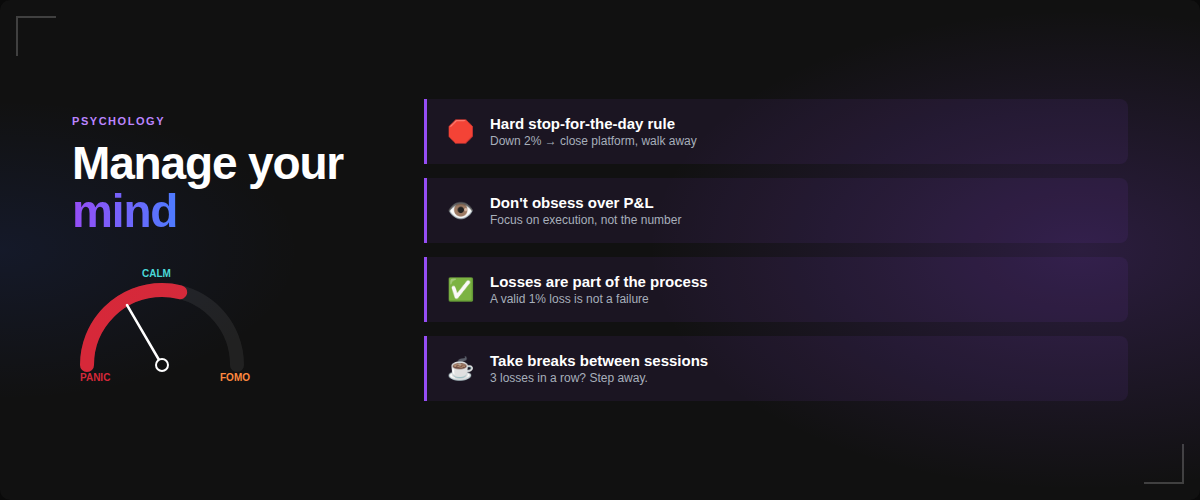
Set a hard stop-for-the-day rule, and define it in advance. Not “if I feel bad” — that’s too subjective. Something concrete: “If I’m down 2% on the day, I close the platform and don’t come back until tomorrow.” Having a pre-defined rule removes the in-the-moment debate about whether you should keep going.
Don’t check P&L obsessively while trades are open. Focus on whether price is doing what you expected, not on the dollar number fluctuating on your screen. Traders who watch P&L too closely tend to cut winners early (because the profit feels good to lock in) and hold losers too long (because closing them makes the loss feel real).
Accept that losses are part of the process. A 1% loss on a trade that fully met your criteria is not a failure. It’s the cost of doing business. The challenge doesn’t require you to be right every time, it requires you to follow your rules consistently and let your edge play out over a sample of trades.
Take breaks. Trading fatigued or frustrated produces measurably worse decisions. If you’ve had three losing trades in a row, or you notice you’re reading into charts more than usual, step away. The market will still be there tomorrow.
Think in terms of sessions, not single days. Some days are just choppy and difficult. One difficult day doesn’t mean your strategy is broken or that you won’t pass, it means you had a difficult day. Keep the sample size large enough to make that distinction clearly.
Use the right platform for the job
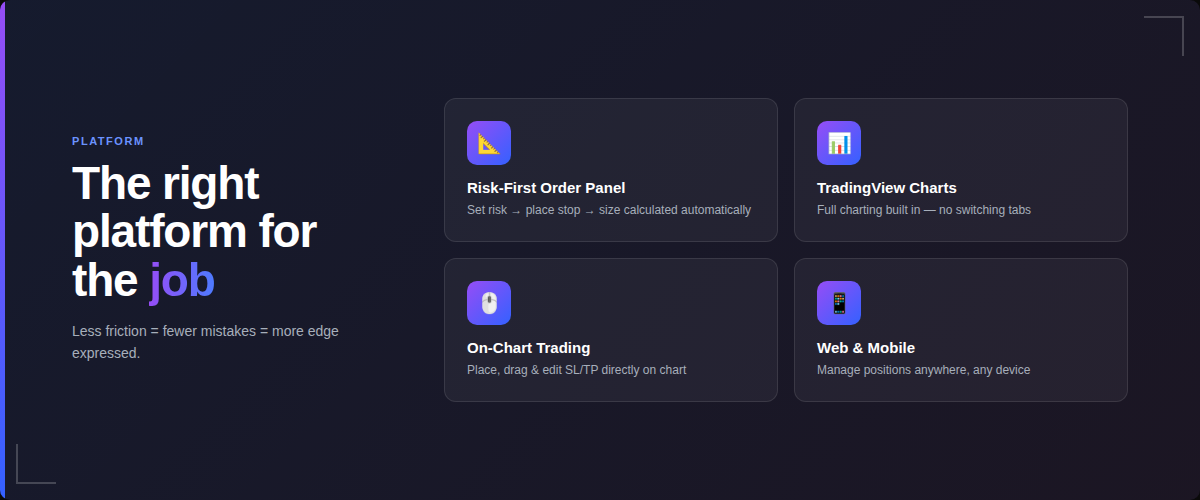
The platform you trade on matters more than most traders acknowledge. Slow execution, a confusing order panel, manual position size calculations, no visible risk controls. These create friction that leads to mistakes. And in a challenge environment, mistakes are expensive.
You want a platform that:
– Makes position sizing from a risk amount easy and fast
– Shows your stop loss and take profit clearly before you enter
– Lets you edit SL/TP visually on the chart once you’re in a trade
– Gives you confidence in execution, especially during fast-moving sessions
TradeLocker is designed with this kind of workflow in mind. The risk calculator calculates position size based on your stop distance and risk amount, on-chart trading lets you place and manage orders directly from the chart, and the overall interface is built to reduce the cognitive load that leads to errors under pressure.
Fewer mistakes in execution means more of your edge actually gets expressed in your results, which matters enormously when the margin for error is tight.
Track your progress and adapt one thing at a time
A challenge isn’t static. You’ll get information from the market across the evaluation period, and that information is valuable, but only if you use it correctly.
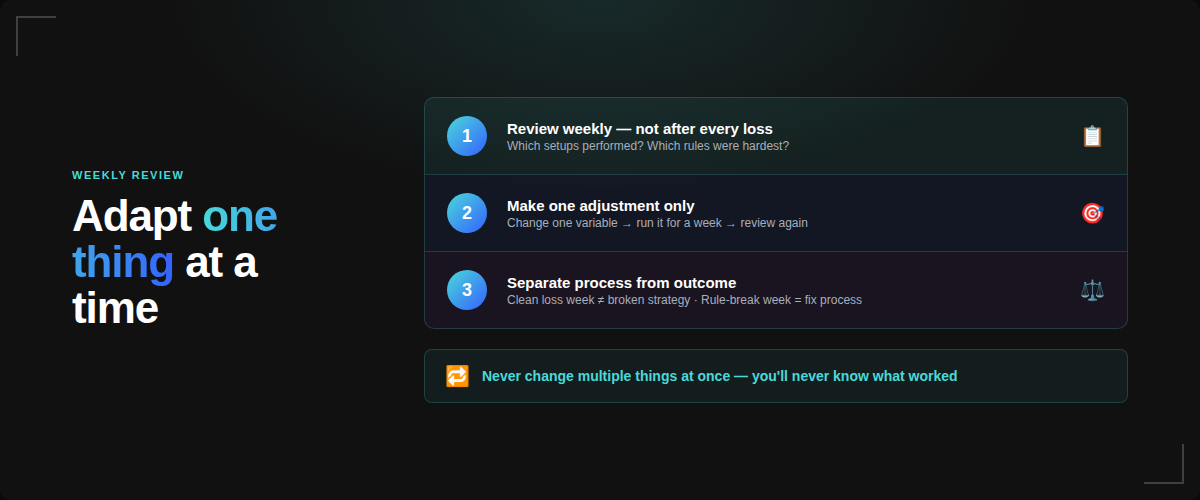
The temptation is to change everything when things aren’t going to plan. Resist it. Changing multiple variables at once means you never understand which change made a difference. Instead:
Review weekly. Once per week, look at your trade log and ask: Which setups performed? Which setups underperformed? Which rule was hardest to follow? Was there a pattern to the losses?
Make one adjustment at a time. If you identify something genuinely worth changing, the time of day you trade, the minimum R:R you accept, the way you manage open trades change one thing and run it for a week. Then review again.
Separate process quality from outcome quality. A losing week with clean execution is very different from a losing week full of rule breaks. The first means your edge had a difficult period. The second means something in your process needs work. Your weekly review needs to make that distinction clearly.
What happens after you pass
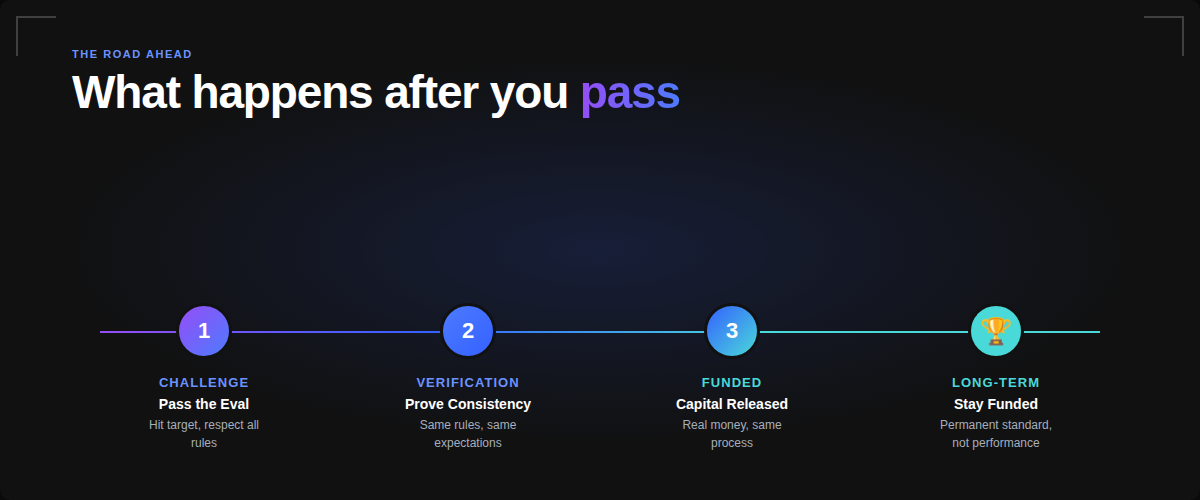
Passing the challenge is the beginning, not the end.
Most firms use a verification or consistency phase before they release funded capital. The rules during this phase are usually similar to the challenge, same drawdown limits, same profit target, same expectations around consistency.
The traders who pass the verification phase are the ones who treated the challenge like a permanent operating standard, not a temporary performance they put on to get through the evaluation.
Everything in this guide — the risk framework, the setup discipline, the daily routine, the post-session review, isn’t just a challenge strategy. It’s how funded traders operate at the level that keeps them funded long-term.
Build it right from the start.
Ready to find your challenge?
If you’re looking for the right prop firm challenge to get started or to take your next step toward a funded account, TradeLocker Hub brings together prop firm challenges from leading firms in one place.
Compare rules, account sizes, profit targets, and drawdown structures side by side, and find the evaluation that fits how you trade.
Browse available challenges on Hub and take the first step toward trading with real capital.

Conclusion
Passing a prop firm challenge comes down to a handful of fundamentals: understanding the rules completely, managing risk tightly, trading only your best setups, staying consistent across the full evaluation window, and keeping your psychology in check when things get hard.
There’s no secret strategy that guarantees you pass. What works is showing up with a process, executing it cleanly, and giving your edge enough room to play out.
Start with a challenge that suits your experience level and account size. Trade it the way you’d trade a funded account, because that’s exactly what you’re being evaluated for.
Disclaimer: This article is for educational purposes only and does not constitute financial advice.
