A demo account is supposed to make you a better trader. For a lot of people, it does the opposite.
That’s not because demo trading is a bad idea. It’s because most traders use it without any of the discipline they’ll eventually need live — and the habits you build in a demo account don’t stay there. They come with you the moment real money is on the line.
The good news: every mistake below is fixable, and most of them take nothing more than a shift in how you approach the practice account you already have.
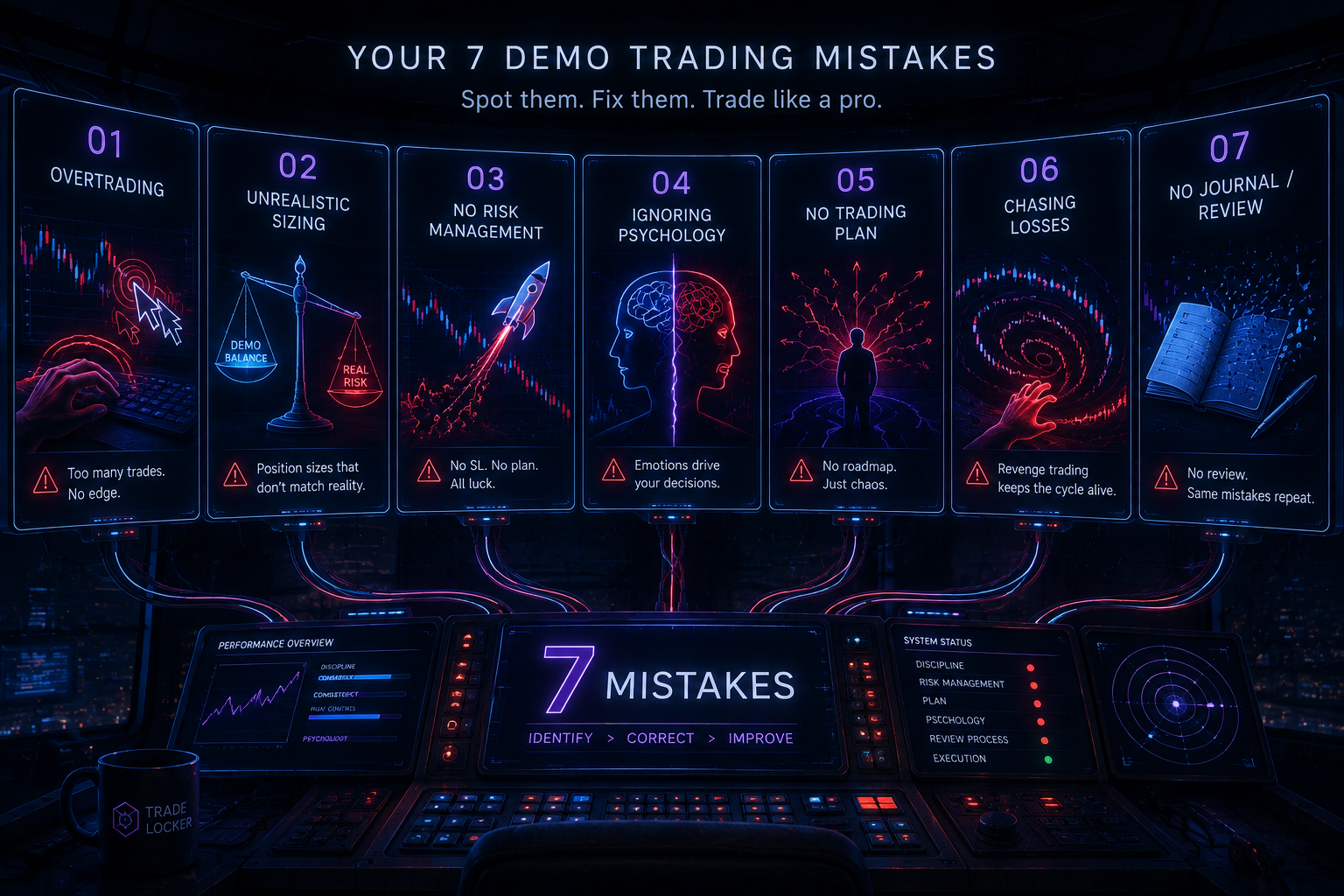
1. Overtrading because the losses don’t feel real
When nothing is actually at stake, there’s no natural brake on how often you click “buy.” Traders who’d never take five trades an hour with real capital do it constantly on demo, because a losing streak just resets with a click.
The problem is that overtrading is a habit, not a one-time decision. Every extra trade you take without a reason trains your hands to act before your plan does. That instinct doesn’t disappear when you fund a live account — it just gets more expensive. It’s worth noting that TradeLocker’s own demo data found that “half of active demo users place their first trade within three and a half minutes” — speed isn’t the problem by itself, but it shows how easy it is to click before you’ve actually thought something through.
Trade demo at the same frequency your live day trading plan would actually allow. If your strategy produces three good setups a day, take three trades. Not thirty.

2. Sizing positions like you have unlimited capital
Most demo accounts start you off with a large simulated balance — TradeLocker’s demo account, for example, hands you $100,000 in virtual funds. That’s great for exploring the platform. It’s terrible for building sizing discipline if you trade it like the number is real.
Going in heavy on demo feels harmless, so it happens constantly: full standard lots, oversized positions, “let’s see what happens” trades that would never survive contact with an actual risk limit. Add leverage into the mix and it’s easy to size a demo position at a multiple of what you’d ever risk live. The sizing habit you build here is the one you’ll default to under pressure later.
Size every demo trade as if the balance were the amount you’d actually risk live. If you’d risk 1% per trade with $2,000, risk 1% of $2,000 on demo — not 1% of $100,000.

3. Trading without a plan or rules
Nothing forces structure onto a demo account. No plan, no consequence — so a lot of demo trading turns into pure improvisation: clicking on gut feel, chasing whatever candle just moved, entering because the chart “looks like it’s about to go.”
That might feel fine when there’s no money behind it. It also means you’re not practicing a process — you’re practicing randomness. When you eventually trade live, you won’t have rules to fall back on, because you never built any. If you haven’t done this yet, it’s worth working through how to create a trading plan before you open the platform again, or reviewing what a trading plan actually looks like with examples.
Write down your entry trigger, stop-loss logic, and risk per trade before you open the platform. Then hold yourself to it on demo exactly as you would live.

4. Skipping the trading journal
“It’s not real money” is the most common excuse for not logging trades — and it quietly wastes weeks of practice. Without a record of what you did and why, there’s nothing to review, which means there’s nothing to learn.
Traders who journal on demo start noticing patterns fast: the setups that actually work, the ones they only think work, the times of day they trade worse, and how their drawdown builds when a few loose trades stack up. Traders who don’t journal repeat the same mistakes for months without realizing it. The trading checklist approach — logging entry reason, size, outcome, and one lesson per trade — works just as well on demo as it does live.
Log four things per trade: your entry reason, your size, the outcome, and one honest lesson. That’s enough to see patterns without turning it into homework.

5. Ignoring trading psychology entirely
It’s easy to treat demo trading as a purely mechanical exercise — click, execute, check the P&L — while ignoring the emotional response underneath it. But impatience, euphoria after a win, tension before an entry: those reactions are exactly what wrecks live accounts, and demo is the cheapest place to notice them.
Skip that step and your first real encounter with trading psychology happens with money on the line, which is the worst possible time to discover you get impulsive after two losses. This is also why realism matters when you choose where to practice — a demo platform that mirrors live execution will surface real emotional reactions; one that feels like a toy won’t.
Track how you felt, not just what happened. A quick note — “felt rushed,” “forced the entry,” “hesitated on a good setup” — tells you more about your future live performance than your demo P&L does.

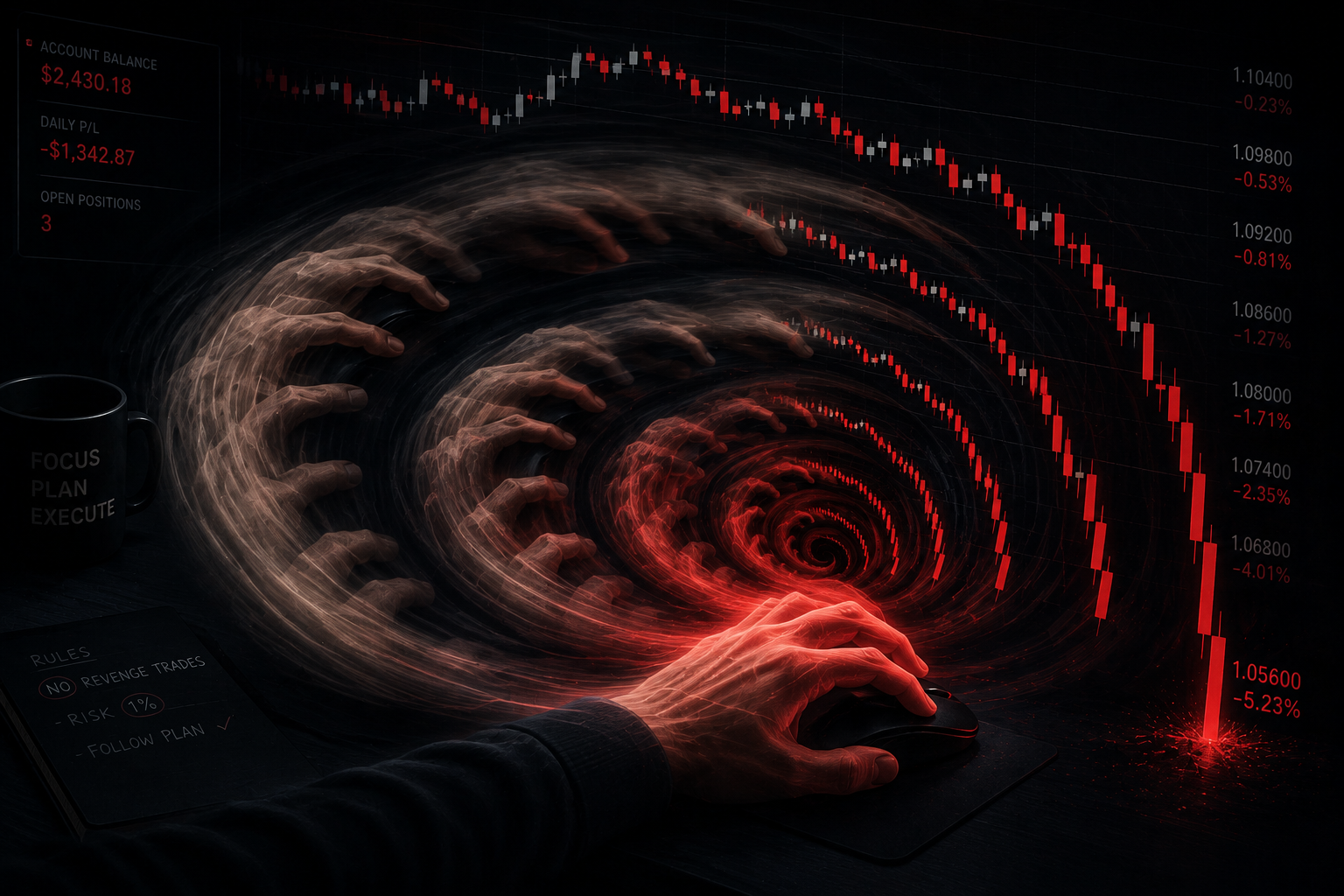
6. Revenge trading after a red streak
Because a losing streak on demo doesn’t cost anything real, the urge to “make it back” goes unchecked. You take a trade you wouldn’t normally take, size it up to recover faster, and repeat that pattern every time you’re down — because so far, it’s been free.
That’s the single most destructive habit in trading, and demo lets it grow completely unsupervised if you let it. Left unchecked, oversized recovery trades are also what push accounts toward a margin stop-out — a forced closure you want to understand on demo, not discover live. A properly placed stop-loss order on every trade is the simplest guardrail against this exact pattern.
Set a no-trade filter now: after two consecutive losses, you stop for a fixed period, no exceptions. Practice the pause on demo so it’s automatic by the time it actually matters.
7. Jumping to live before proving consistency
A few green days on demo can feel like proof you’re ready. It isn’t. A short winning streak is a small sample size, not a track record — and switching to live on the strength of it usually means discovering your gaps with real money instead of fake money. Execution itself can shift too: things like slippage and fill quality often behave differently once you’re trading live through an actual broker, which is one more reason to understand how your broker actually executes your orders before you switch.
The traders who transition well don’t go live because they feel ready. They go live because they defined what “ready” means in advance and actually hit that bar — the same discipline it takes to pass a prop firm challenge, where consistency is graded, not assumed.
Set an objective threshold before you start — for example, 20 to 30 trades that follow your rules, sized correctly, with a journal entry for each. Go live when you hit the number, not when you feel lucky. When you do, you can connect a supported broker or prop firm and carry the same rules straight into your live account.

The point of demo trading
Every mistake above breaks the same thing: the transfer between practicing and trading. Demo trading isn’t valuable because it lets you avoid losses — it’s valuable because it’s where you build the habits, instincts, and rules that are supposed to carry straight into your live account. Trade it the way you’d trade for real, and it will actually prepare you. Trade it like a game, and it will teach you nothing except how to click buttons.
👉 Try TradeLocker Demo for free
FAQ
How long should I demo trade before going live?
There’s no universal number, but consistency matters more than time. Most traders benefit from demo trading until they can follow their own sizing and exit rules across 20–30 trades without breaking them.
Does demo trading really prepare you for live trading?
It can — but only if you trade the demo account with the same rules, sizing, and discipline you plan to use live. Treat it like paper trading money and skip the discipline, and it won’t transfer. For more on the distinction, see what paper trading actually is.
What’s the biggest mistake new demo traders make?
Sizing and frequency, more than anything else. Trading too big and too often on demo builds habits that don’t survive contact with a real account.
Should I use the same strategy on demo and live?
Yes. Switching strategies when you go live means your demo results tell you nothing about what to expect. Keep the strategy, the sizing rules, and the process identical — the same rules you laid out in your trading plan.
Disclaimer: This article is educational and not financial advice.
